
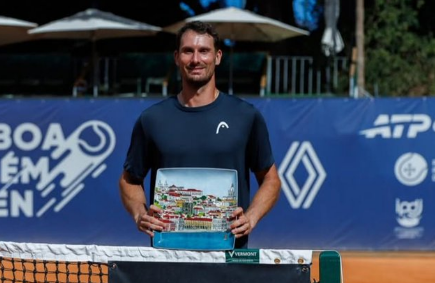
Alexander Ritschard was 22 when doctors told him they had come within minutes of amputating his right arm.
He was studying at the University of Virginia in 2015 when he experienced a sharp pain in his shoulder during a gym session. What initially appeared to be a minor injury turned out to be a blocked artery that had stopped blood flowing properly into his arm.
Three operations followed. His lungs filled with blood after one procedure, and a stent was inserted to maintain circulation.
Even after recovering, Ritschard was unsure whether he would ever play professional tennis.
More than a decade later, the Swiss player is still competing. On Sunday, at 32, he won the Lisboa Belém Open for the second time, defeating Svyatoslav Gulin 6–2, 6–1 in just 62 minutes.
The victory came after another difficult period of injuries, one that had again left Ritschard considering retirement.
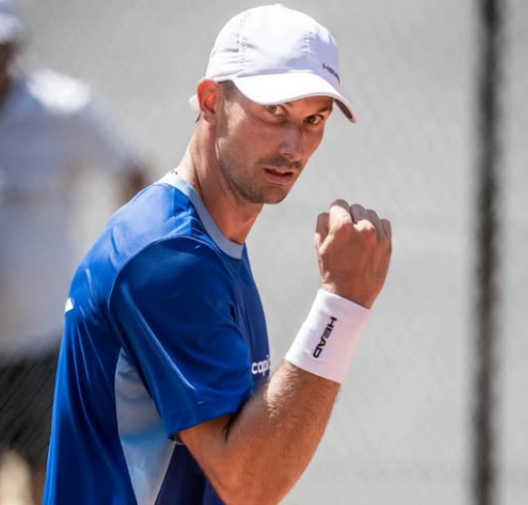
Five minutes from losing his arm
Ritschard has spoken openly about the medical emergency that nearly ended his career before it began.
In a 2023 interview with the ATP, he recalled initially dismissing the pain in his shoulder as a possible muscle strain.
The situation deteriorated rapidly.
Doctors discovered that an artery had become blocked, preventing blood from reaching his right arm. Emergency surgery was required to restore circulation.
Ritschard later explained just how close he had come to losing the limb.
“They said they had to make a decision within the next five minutes and it wasn’t opening.”
The artery eventually reopened, allowing blood to flow again.
But the operations were only the beginning of his difficulties.
A problem involving a rib had contributed to the arterial blockage, requiring further surgery. Complications involving his lungs led to a third procedure.
Afterwards, Ritschard was unable to train for more than 90 minutes at a time.
He struggled to imagine how he could pursue professional tennis with such a restriction.
“I was thinking about quitting right after college,” he told the ATP.
His concerns were understandable. Professional tennis requires hours of training, frequent matches and sustained physical effort. Ritschard had no guarantee that his arm would tolerate those demands.
He nevertheless continued playing college tennis, helping Virginia win three consecutive NCAA team championships between 2015 and 2017.
He also developed an interest in electronic music production and DJing during his recovery, performing at festivals and nightclubs with a college friend.
For a period, music appeared a more realistic career than professional tennis.
A breakthrough that took years
Ritschard eventually committed to the professional circuit, although his progress was considerably slower than that of many established ATP players.
He earned his first ATP ranking point at 16 but did not enter the world’s top 200 until he was 28.
In 2022, he won his first Challenger title in Hamburg and qualified for the main draws at Wimbledon and the US Open.
He faced Stefanos Tsitsipas at Wimbledon and Félix Auger-Aliassime in New York, taking a set from both. The results confirmed that he could compete against established players, but consistency remained elusive.
Ritschard later credited coach Juan Ramirez with changing how he approached his career. Ramirez encouraged him to concentrate on the daily work rather than becoming frustrated by individual results.
The Swiss player acknowledged that he had spent years struggling to manage his impatience.
“I feel like I’ve only really started doing things right and professionally about two years ago.”
That was Ritschard speaking in 2023, when he was already approaching 30. His next breakthrough came the following season.
In September 2024, Ritschard defeated Raphael Collignon in the Lisbon Challenger final, claiming his third Challenger title of the year.
The result lifted him into the world’s top 100 for the first time.
He was 30.
The changes behind his best season
Ritschard’s improvement in 2024 was accompanied by changes to his preparation. His partner, nutritionist Kat Berglas, helped develop a program tailored to the demands of his body and playing style.
Ritschard had previously struggled with maintaining sufficient energy during matches. He explained that he burned carbohydrates quickly and lost considerable amounts of fluid and salt through perspiration.
Embed from Getty ImagesBerglas helped him change what he ate before matches, how much he consumed during competition and the composition of his drinks.
“She was the missing piece I kind of needed to do what I’m doing now,” he told the ATP.
The changes were extensive.
Ritschard increased his carbohydrate intake, began eating more consistently during matches and paid closer attention to hydration.
He also continued working on the psychological aspects of competition.
In a 2025 interview with Tennisnerd, he explained that he preferred reading, journaling and studying his own behaviour to conventional sessions with a mental coach.
The process helped him understand his reactions to difficult situations. His assessment of life on the professional circuit was particularly revealing.
“Pro tennis is chaos. It’s never the same conditions, the same ball, the same opponent.”
By the end of 2024, Ritschard had reached a career-high ranking of No. 99.
He had finally achieved a goal he had pursued since childhood. But the following two seasons brought another series of physical setbacks.
Back to qualifying at 32
Shoulder, back and thigh injuries disrupted Ritschard’s schedule, sending his ranking down to No. 483 by the time he returned to Lisbon this October.
Earlier in the year, he had considered retirement. His return to competitive form began on the ITF circuit.
Embed from Getty ImagesIn August, he won an M25 tournament in Oviedo, Spain, defeating Sergi Pérez Contri in two tiebreaks. He followed that with another M25 title in Zaragoza in early October, beating Alejandro Moro Cañas 6–3, 6–2 in the final.
Those victories helped rebuild his confidence and ranking, but he still needed to qualify for the Lisbon Challenger.
He defeated João Dinis Silva and Andrej Martin to reach the main draw.
From there, he beat Carlos Taberner, Raul Brancaccio, Sumit Nagal and top seed Marco Trungelliti to reach the final.
Brancaccio was the only player to take a set from him during the tournament. His final opponent, Svyatoslav Gulin, had also begun the week in qualifying.
The Russian lost his final qualifying match but entered the main draw as a lucky loser. He then won five matches to reach his first Challenger final.
Ritschard, however, gave him little opportunity to settle.
The Swiss player saved all four break points he faced and won 74 per cent of his first-serve points.
He also won an unusually high 76 per cent of points behind his second serve. The match lasted just 62 minutes.
Ritschard became the first two-time champion in the tournament’s ten-year history.
The Federer comparison
Ritschard’s performance was so convincing that Gulin jokingly compared him to Roger Federer during the final. The Swiss player enjoyed the comparison but was quick to point out the differences.
“I am still missing a few Grand Slam titles for that [laughs]… and a one-handed backhand.”
Speaking at his post-tournament press conference, Ritschard explained that his serve and forehand had worked particularly well. He felt comfortable controlling rallies and imposing his preferred patterns of play.
The result was his fifth Challenger singles title and his first at that level since winning the same tournament in 2024.
Lisbon had been the setting for his first entry into the top 100. Two years later, it provided another important victory after a prolonged period of injuries.
Why he considered retirement
Ritschard’s post-final comments also offered a more serious explanation of what he had experienced. He revealed that the injuries had been the principal reason he considered ending his career.
The desire to compete had not disappeared.
He still believed he could achieve more in tennis, but he was increasingly conscious of the physical consequences of continuing.
“I still feel I have something to give to this sport and I feel young.”
He added that he wanted to continue competing in good physical condition rather than endure persistent pain.
The artery problem in 2015 had almost cost him his arm. The injuries that followed his top-100 breakthrough were different, but they again forced him to consider whether continuing professional tennis was worth the physical risk.
Ritschard has previously spoken about the gratitude he feels towards the doctors who treated him. In a 2024 ATP interview, he recalled that one of his surgeons still expressed amazement at his recovery whenever he returned for a check-up.
The medical emergency has not prevented him from playing professional tennis, although it remains an important part of his history.
His more recent injuries have created a different challenge: deciding how long he wants to continue competing on the gruelling merry-go-round that is the tennis tour.
Another opportunity
The Lisbon title is unlikely to settle that question immediately.
Ritschard will climb substantially in the rankings, improving his opportunities to enter Challenger tournaments without qualifying. But returning to the top 100 will require sustained results over the coming months.
His physical condition will determine how regularly he can compete. Ritschard has already experienced the uncertainty of rebuilding his career more than once.
He spent years working towards his first Challenger title, reached the top 100 at 30, then watched injuries interrupt his progress.This season, he returned to ITF tournaments to regain his ranking and match fitness.
At 32, he has now won another Challenger title. That result far from guarantees that he will return to the highest level he has reached.
But after considering retirement earlier this year, Ritschard has given himself another opportunity to find out.
Continue Reading
- ATP Challenger Tour Explained
- ITF World Tennis Tour Explained
- Tennis Ranking Points Explained
- Tennis Prize Money Explained
Read more of our exclusive feature articles here.
Read more of our player focus articles here.
Follow The Tennis Site on X: @thetennissite
Follow Todd Scoullar on X: @toddscoullar

Comments are closed, but trackbacks and pingbacks are open.