

Eight singles players, eight doubles teams and one final opportunity to claim one of the biggest titles in women’s tennis.
The WTA Finals bring together the season’s most successful players for a championship unlike almost anything else on the professional circuit.
Unlike the Grand Slams or regular WTA tournaments, losing a match does not necessarily mean elimination. Players compete in a round-robin group stage before the leading performers advance to the semifinals.
It is a format that can produce unusual scenarios. A player might win her opening two matches and still need a result in her final group match, while another can recover from an early defeat and eventually lift the trophy.
With substantial prize money, valuable ranking points and a history stretching back to 1972, the WTA Finals have become one of the most prestigious events in women’s professional tennis.
But how does the tournament work, who qualifies and what makes it different from the rest of the WTA calendar?
What Are the WTA Finals?
Quick Answer: The WTA Finals are the season-ending championship of women’s professional tennis. Eight singles players and eight doubles teams qualify through their results during the season. Both competitions begin with two round-robin groups of four, followed by semifinals and a final. An undefeated champion can earn up to 1,500 ranking points.
The tournament is the culmination of the annual WTA season.
Throughout the year, players compete at Grand Slams, WTA 1000, WTA 500 and WTA 250 tournaments, accumulating points that contribute towards qualification.
Only eight singles players and eight doubles teams reach the season-ending championship.
That exclusivity is a major part of its appeal.
At a Grand Slam, 128 players begin the singles main draw. At the WTA Finals, the entire field consists of players who have earned their places through their performances during the season.
There are no conventional early rounds against lower-ranked opponents. High-profile matches begin immediately.
The singles champion receives the Billie Jean King Trophy, while the doubles champions are awarded the Martina Navratilova Trophy.
For a broader explanation of the women’s professional circuit, see WTA Tour Explained.
How Do Players Qualify for the WTA Finals?
Qualification is determined by the Race to the WTA Finals, which measures players’ results during the current season.
This is different from the regular WTA rankings.
The traditional world rankings operate on a rolling 52-week system, with points from previous tournaments eventually dropping off.
The Race, by contrast, concentrates on results accumulated during the current calendar year.
As the season progresses, the standings reveal which players are in contention for the championship.
The Top Seven and the Grand Slam Champion Rule
Under the current qualification system, the top seven eligible singles players in the Race qualify for the WTA Finals.
The eighth position is subject to an additional provision.
It is reserved for the highest-ranked Grand Slam singles champion from the current season who has not already qualified and is positioned between No. 8 and No. 20 in the Race.
If no Grand Slam champion meets those conditions, the final position goes to the next eligible player in the Race standings.
Consider a hypothetical example.
A player finishes eighth in the Race without winning a Grand Slam. Another finishes 12th but has won Wimbledon.
Provided the Wimbledon champion meets the eligibility requirements, she would take the final qualifying position ahead of the player ranked eighth.
The rule gives additional recognition to players who have achieved the sport’s biggest individual prize during the season.
However, winning a Grand Slam does not automatically guarantee a place. A major champion who finishes outside the top 20 in the Race cannot qualify through this provision alone.
The doubles competition uses a comparable system, with qualification based on the results of doubles partnerships.
Can a Player Qualify Without Winning a Tournament?
Yes.
A player does not need to win a title to reach the WTA Finals.
Consistently reaching quarterfinals, semifinals and finals at major tournaments can generate enough points to secure qualification.
In some cases, a player with several titles might finish behind someone who has won fewer tournaments but performed more consistently at higher-level events.
That is one reason the Race provides such an interesting storyline throughout the season.
For more information on the points system, see Tennis Ranking Points Explained.
How Does the WTA Finals Format Work?
The WTA Finals use a round-robin format followed by a knockout stage.
It is the tournament’s defining characteristic.
The Round-Robin Stage
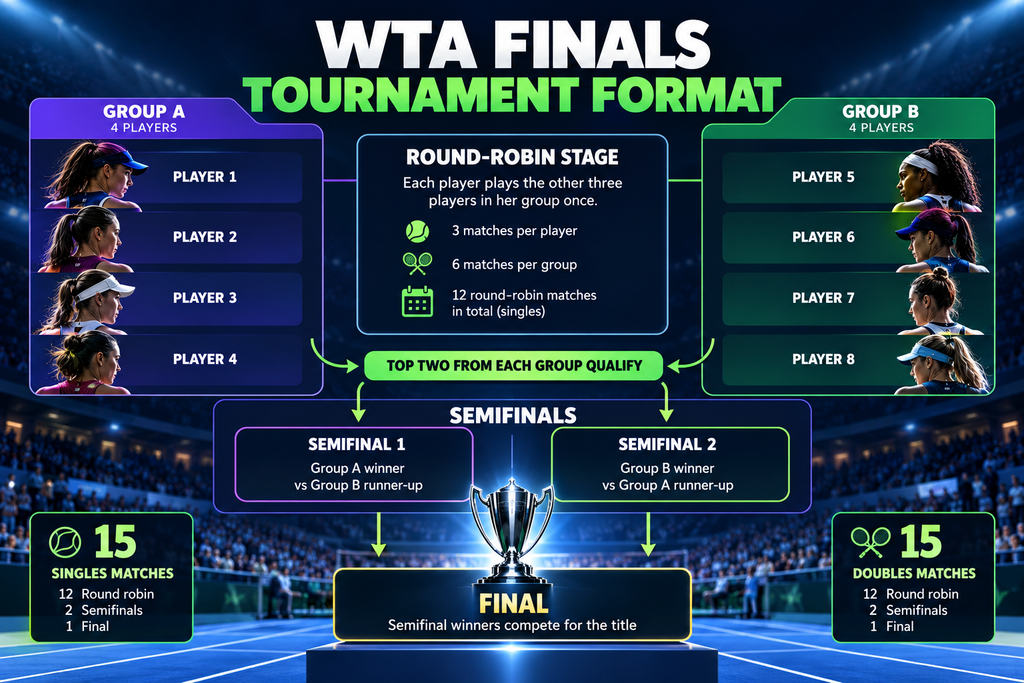
The eight singles players are divided into two groups of four.
Each player faces the other three members of her group once, meaning everyone is scheduled to play three round-robin matches.
Each group therefore produces six matches, giving the singles competition 12 group-stage matches overall.
The top two players from each group advance to the semifinals.
The doubles competition follows the same structure.
How the Semifinals Work
The semifinal draw is determined by the final group standings.
The winner of Group A plays the runner-up from Group B.
The winner of Group B plays the runner-up from Group A.
The two semifinal winners then meet in the championship match.
| Stage | Singles matches |
|---|---|
| Round robin | 12 |
| Semifinals | 2 |
| Final | 1 |
| Total | 15 |
The doubles competition also features 15 scheduled matches under the standard format.
This produces 30 scheduled matches across the two competitions, assuming no withdrawals or other interruptions.
Can a Player Lose and Still Win the WTA Finals?
Yes, and this is one of the most fascinating aspects of the championship.
At Wimbledon, Roland Garros, the Australian Open or the US Open, a singles defeat ends a player’s tournament.
At the WTA Finals, a player can lose during the group stage and still become champion.
For example, a player could lose her opening match, win the next two, qualify for the semifinals and then win both knockout matches.
She would finish as champion with four victories and one defeat.
A player can even progress from the group stage with only one victory if the other results and tiebreaking procedures work in her favour.
The format rewards players who can recover from setbacks.
It also means that a match can remain important even after one player has already secured a semifinal position.
Group placement, qualification scenarios and the possibility of a three-way tie can all influence the significance of the final round-robin matches.
There is another unusual possibility: two players can meet twice during the tournament.
If they play in the same round-robin group and both reach the final, they will face each other again for the championship.
That simply cannot happen in a conventional single-elimination singles draw.
What Happens When Players Finish Level in a Group?
With four players competing in each group, ties are possible.
Three players might each finish with two victories and one defeat. Alternatively, three players could each win only once.
When two players finish level, their head-to-head result is normally decisive, provided both have completed the required matches.
Three-way ties are more complicated.
The WTA’s official procedures consider the number of matches played, the percentage of sets won and, where necessary, the percentage of games won. Head-to-head results can also become relevant as the tie is narrowed.
This makes every set potentially valuable.
A player who loses in three sets may be better positioned in a tiebreaking scenario than someone who loses in straight sets.
And if the group remains exceptionally close, individual games can make the difference between reaching the semifinals and being eliminated.
It is one of the reasons WTA Finals matches can remain competitive even when the eventual winner appears certain.
How Many Ranking Points Are Available at the WTA Finals?
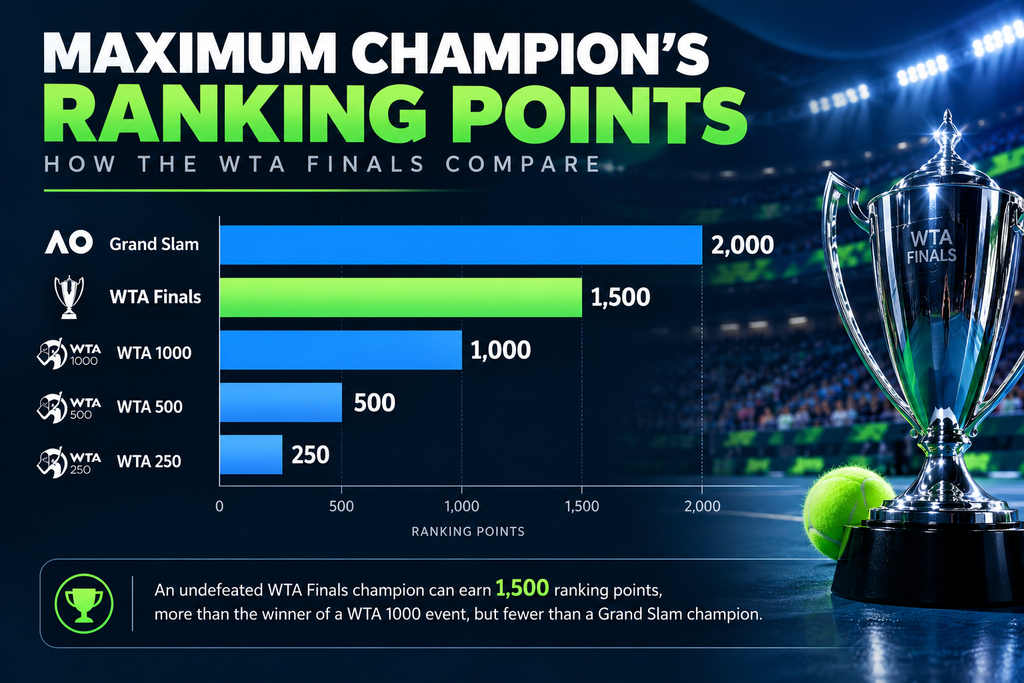
An undefeated WTA Finals champion can earn a maximum of 1,500 ranking points.
Unlike a conventional tournament, where points are primarily determined by the round reached, the WTA Finals award points for individual victories throughout the competition.
Under the 2026 WTA rulebook, the distribution is:
| Achievement | Ranking points |
|---|---|
| Each round-robin victory | 200 |
| Semifinal victory | 400 |
| Final victory | 500 |
| Maximum for an undefeated champion | 1,500 |
An undefeated champion earns 600 points from three round-robin victories, another 400 for winning her semifinal and 500 for winning the final.
A champion who loses one group match would earn 1,300 points, while a champion who wins only one group match would earn 1,100.
The system rewards both progression through the tournament and performance during the group stage.
How Do the Points Compare With Other Tournaments?
| Tournament | Maximum champion’s points |
|---|---|
| Grand Slam | 2,000 |
| WTA Finals | 1,500 |
| WTA 1000 | 1,000 |
| WTA 500 | 500 |
| WTA 250 | 250 |
The WTA Finals therefore offer more ranking points to an undefeated champion than any regular WTA Tour event.
Only a Grand Slam title carries a higher maximum.
These points can be particularly important because the championship takes place at the end of the season.
A player chasing the year-end world No. 1 ranking may arrive at the WTA Finals with a relatively small deficit.
A strong performance can change the final standings, while an early exit can leave the door open for a rival.
In a close ranking race, the WTA Finals can determine who finishes the season at the top of women’s tennis.
How Much Prize Money Is Available at the WTA Finals?
The WTA Finals have become one of the richest events in women’s sport.
The prize money reflects both the tournament’s prestige and the commercial growth of professional women’s tennis.
In 2025, the championship in Riyadh offered a record US$15.5 million prize fund.
| Competition | 2025 prize money |
|---|---|
| Singles | US$12.4 million |
| Doubles | US$3.1 million |
| Total | US$15.5 million |
An undefeated singles champion could earn US$5.235 million.
A champion who lost one round-robin match would receive US$4.88 million.
The maximum doubles championship prize was US$1.139 million for an undefeated team.
These figures illustrate the considerable financial rewards available at the season-ending championship.
Why Can Two Players Receive Different Amounts for Reaching the Same Stage?
Like the ranking-points system, the WTA Finals prize-money structure rewards individual performances.
Players receive payments based on participation and match victories, with additional rewards for progressing through the knockout rounds.
As a result, two semifinalists may earn different amounts if one has won three round-robin matches and the other has won only two.
Similarly, an undefeated champion receives more than a champion who suffered a group-stage defeat.
The exact prize-money schedule is determined for each edition and should be checked annually.
For a broader comparison of earnings throughout professional tennis, see Tennis Prize Money Explained.
When and Where Are the WTA Finals Played?
The WTA Finals are normally held near the end of the women’s professional tennis season, typically in October or November.
Unlike the four Grand Slams, which have permanent host cities, the season-ending championship has moved between venues throughout its history.
New York, Los Angeles, Singapore, Shenzhen, Guadalajara, Fort Worth, Cancún and Riyadh have all hosted the competition.
This changing location has helped bring the event to different tennis markets around the world.
WTA Finals 2026: Indian Wells
The 2026 WTA Finals will be held at the Indian Wells Tennis Garden in California from November 8–15.
The tournament will be played on hard courts.
Indian Wells is best known for hosting the BNP Paribas Open, one of the largest combined ATP and WTA tournaments outside the Grand Slams.
Its established facilities and reputation make it a significant venue for the season-ending championship.
The 2026 singles field was completed on October 21, when Karolína Muchová secured the final qualification place.
The eight qualifiers are:
- Elena Rybakina (KAZ)
- Aryna Sabalenka (BLR)
- Mirra Andreeva (RUS)
- Jessica Pegula (USA)
- Coco Gauff (USA)
- Elina Svitolina (UKR)
- Linda Nosková (CZE)
- Karolína Muchová (CZE)
The group draw and match schedule are separate from qualification and are confirmed by the tournament.
Because the venue, dates and field change from year to year, this section should be refreshed annually while the rest of the article remains evergreen.
Embed from Getty ImagesThe History of the WTA Finals
The WTA Finals have a history stretching back more than five decades.
The first championship took place in Boca Raton, Florida, in 1972, one year before the Women’s Tennis Association was formally established.
The inaugural tournament was known as the Virginia Slims Championships.
Chris Evert won the first singles title, defeating Kerry Melville, later known as Kerry Reid, in the final.
The original tournament was very different from today’s eight-player round-robin competition. It featured a larger knockout draw, and the event underwent several changes in format, scheduling and location over subsequent decades.
As women’s professional tennis developed, the championship became an increasingly important fixture.
New York was a particularly significant home for the tournament, with Madison Square Garden hosting many memorable editions.
The WTA Finals also became a showcase for some of the sport’s greatest rivalries.
Chris Evert and Martina Navratilova were central figures during the tournament’s early decades, followed by champions such as Steffi Graf, Monica Seles, Martina Hingis, Kim Clijsters, Justine Henin and Serena Williams.
In more recent years, the event has produced a variety of champions, including established Grand Slam winners and players claiming one of the biggest titles of their careers.
That history gives the WTA Finals a status extending well beyond its position as the final major tournament of the season.
Who Has Won the Most WTA Finals Titles?
Martina Navratilova holds the record for the most WTA Finals singles titles, with eight.
She also won 13 doubles championships at the event.
Navratilova’s success during the late 1970s and 1980s established a benchmark that no other player has matched in singles.
Steffi Graf and Serena Williams each won five WTA Finals singles titles, placing them among the most successful champions in the tournament’s history.
Chris Evert won four, while Monica Seles and Kim Clijsters each captured three.
These achievements underline how the championship has repeatedly rewarded players capable of maintaining their form across an entire season.
Recent WTA Finals Singles Champions
| Year | Champion |
|---|---|
| 2025 | Elena Rybakina |
| 2024 | Coco Gauff |
| 2023 | Iga Świątek |
| 2022 | Caroline Garcia |
| 2021 | Garbiñe Muguruza |
| 2020 | Not held |
| 2019 | Ashleigh Barty |
| 2018 | Elina Svitolina |
| 2017 | Caroline Wozniacki |
The 2020 championship was cancelled during the COVID-19 pandemic.
One of the interesting features of the recent winners is the variety of players who have succeeded.
Some arrived as dominant figures in women’s tennis. Others used the championship to produce one of the finest weeks of their careers.
In 2025, Elena Rybakina defeated Aryna Sabalenka 6–3, 7–6(0) in the final in Riyadh, completing an undefeated championship run.
The victory provided a striking example of how the WTA Finals can deliver a defining conclusion to a player’s season.
Embed from Getty ImagesHow Are the WTA Finals Different From a Grand Slam?
Both competitions occupy prestigious positions in women’s tennis, but they test players in different ways.
| Feature | WTA Finals | Grand Slam |
|---|---|---|
| Singles field | 8 players | 128 players |
| Entry | Season-long Race | Rankings, qualifying and wild cards |
| Format | Round robin, then knockout | Single elimination |
| Can a player lose and still win? | Yes | No |
| Maximum ranking points | 1,500 | 2,000 |
| Scheduled singles matches | 15 | 127 |
| Events per year | 1 | 4 |
A Grand Slam champion must normally win seven consecutive singles matches against a large field.
At the WTA Finals, a player competes against an unusually concentrated group of elite opponents, with every match potentially affecting qualification for the knockout stage.
The challenge is different.
At a Grand Slam, players must survive an extended draw without defeat.
At the WTA Finals, they must negotiate a small but exceptionally strong field, manage the complications of group standings and then win the decisive knockout matches.
Neither achievement is straightforward, and both occupy important places in the history of professional tennis.
For more information, see Grand Slam Tennis Explained.
Why the WTA Finals Matter
The WTA Finals are more than an exhibition of the season’s leading players.
Qualification represents a significant achievement in itself. Reaching the event usually requires months of consistent performances against the world’s best competition.
Winning it requires another level of excellence.
The round-robin format offers opportunities for recovery, but it also creates pressure from the opening match.
A single lost set can eventually influence qualification. A narrow victory can prove decisive. And a player who has already suffered defeat may still emerge as champion.
The tournament also carries substantial consequences for the final world rankings and provides one of the largest financial rewards in women’s tennis.
Its history, meanwhile, connects generations of champions who have shaped the sport.
For some players, the WTA Finals crown is the final achievement in a dominant season.
For others, it is the breakthrough that elevates an excellent year into an unforgettable one.
Either way, the championship offers a fitting conclusion to the WTA season: a small field, an unusual format and the opportunity to finish the year by defeating the very best.
Continue Reading
- WTA Tour Explained
- Grand Slam Tennis Explained
- Tennis Ranking Points Explained
- Tennis Prize Money Explained
- WTA 1000 Tournaments Explained
Read more of our exclusive feature articles here.
Read more of our player focus articles here.
Follow The Tennis Site on X: @thetennissite
Follow Todd Scoullar on X: @toddscoullar

Comments are closed, but trackbacks and pingbacks are open.