
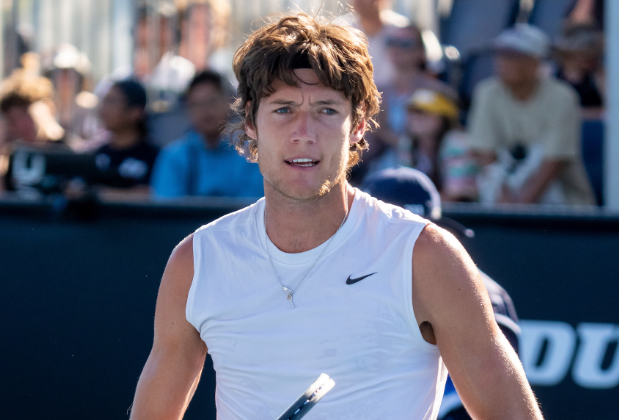
Nine singles titles in one season should be enough to convince anyone that Matthew Dellavedova knows how to win a tennis tournament.
The Australian has spent much of 2026 doing precisely that, collecting trophies across the ITF World Tennis Tour with a consistency few players can match.
His latest success came on Sunday in China, where he defeated Martin Borisiouk 6-4, 7-6(4) to win the M25 Qian Daohu title, his ninth ITF singles crown of the year.
Yet Dellavedova’s achievements raise a question that has followed him for several seasons now.
How does a player who wins so regularly at ITF level turn that success into a sustained career on the ATP Challenger Tour, and beyond?
For Dellavedova, it is a question he has already spent considerable time considering. And his own explanation of the difficulties involved, reveals why the next stage of his career may prove considerably harder than the last.
A season of extraordinary consistency
Matthew Dellavedova’s ninth ITF singles title of 2026 has taken an already remarkable season to another level.
The 26-year-old Australian defeated Martin Borisiouk 6-4, 7-6(4) in Sunday’s M25 Qian Daohu final in China, completing another unbeaten week on the ITF World Tennis Tour.
His latest triumph takes his calculated season record to 89 wins and 19 defeats, an impressive winning percentage of 82.4%.
No other player on the men’s ITF World Tennis Tour has come close to matching his volume of victories this season. Before Qian Daohu, Dellavedova already held a 30-win advantage over his nearest rival.
Nine titles, 89 victories and a winning percentage above 82% are extraordinary numbers at any level of professional tennis.
But Dellavedova is aware that dominating the ITF circuit is one thing. Establishing himself on the ATP Challenger Tour is another.
And he understands the difficulties better than most.

‘I Can Match it With Those Guys’
In January 2025, Dellavedova spoke to The First Serve about his ambition to establish himself on the ATP Challenger Tour.
He had already spent years navigating the lower levels of professional tennis and believed his game was capable of competing against stronger opposition.
“I feel like I can match it with those guys, I feel like I belong there,” he said.
The ambition was clear. But Dellavedova’s explanation of what separated the two circuits was more revealing.
“I generally think that it’s more the environment, the ball change [going from] max 11 or 13 in the futures to nine or 11. That makes a big difference,” he explained.
The reference was to differences in ball-change schedules within sets, something that can affect how much the balls fluff up, and how much more difficult it can be to finish points off with the ball travelling slower through the air.
For a player accustomed to competing at ITF events, the adjustment is one of several challenges that come with moving up.
Dellavedova also highlighted the difficulty of maintaining a consistent routine.
“Also, the way the Challengers are scheduled, it’s very different. You’re travelling more every week. I found when I was in the Futures, it was easier to structure your schedule, you could stay at one place for a few weeks to get used to the environment, get used to the courts. If you felt good, you knew you were going to perform pretty well.”
At Challenger level, that familiarity can disappear quickly.
“Whereas the Challenger you have to play one week, move onto the next and readjust to get used to different conditions.”
For players operating outside the world’s top 100, the demands of constant travel are familiar. But Dellavedova’s comments do show how even relatively small changes can become significant when the standard of competition increases.
A player who has settled into a particular venue, court surface and set of conditions might enjoy several successful weeks at ITF level.
On the Challenger Tour, the following Monday can mean a different country, a different tournament and a difficult opening-round opponent.
And, as Dellavedova pointed out, there are rarely easy matches.
“In Futures, you might get a couple of the guys early on in rounds that you feel like you can get through. You just don’t get that in Challengers [because] you’re often playing against guys [who are] ex-top-100 or the very, very good juniors who often make breakthroughs only a few months after you play them.”
Those observations are particularly interesting in light of his 2026 results.
Dellavedova has become accustomed to entering ITF tournaments with a genuine expectation of reaching the final stages.
At Challenger level, he knows that even surviving the opening round can require a considerably higher standard of performance.
His challenge is not simply to play better tennis. It is to reproduce the consistency he has developed while competing against stronger opponents, often in less familiar surroundings.
Luka Mikrut: Sometimes the quickest way forward is backwards
Croatia’s Luka Mikrut faced a similar problem in 2025.
The former junior world No. 40 had been struggling for victories at Challenger level. Rather than continue chasing results against stronger opposition, he and his team made a deliberate decision to return to ITF tournaments.
Speaking to the ITF later that year, Mikrut explained:
“At the end of last year I was struggling with confidence and winning matches. I decided in March to take a step back from Challengers and go to the World Tennis Tour to play more matches and get more wins. To get my confidence back.”
What followed was extraordinary.
Mikrut won four consecutive ITF titles, collecting 20 straight victories without dropping a set.
He began with M15 Antalya before adding titles at M15 Opatija, M25 Antalya and M15 Dubrovnik.
Forty consecutive sets won, and suddenly the Croatian was approaching Challenger tennis with a very different outlook.
In August, he captured his first Challenger title in Como, Italy. Two months later, he won another in Braga, defeating Vilius Gaubas in the final.
The results helped him reach a career-high ranking of No. 159.
Mikrut later credited his spell on the ITF circuit with helping him rediscover the confidence necessary to compete at a higher level.
His coach offered another important detail. Alongside the victories, Mikrut had been working on technical changes, particularly to his serve.
The titles were helping him win matches, but the work behind the scenes was helping him become a better player.
That is what makes Mikrut’s story relevant to Dellavedova.
Winning at ITF level can be an important development strategy. The challenge is ensuring those victories are accompanied by improvements that will hold up against stronger opposition.
For Mikrut, that approach delivered two Challenger titles in the same season.
Dellavedova will be hoping his own extended period of success can produce a similar outcome.

Improve your game and discover your true potential by increasing your concentration, willpower and confidence.
Described by Billie Jean King as her ‘tennis bible’, Timothy Gallwey’s multi-million bestseller, including an introduction from acclaimed sports psychologist Geoff Beattie, has been a phenomenon for players of all abilities since it was first published in 1972.
Instead of concentrating on how to improve your technique, it starts from the understanding that ‘every game is composed of two parts, an outer game and an inner game’. The former is played against opponents on the court, but the latter is a battle within ourselves as we try and overcome self-doubt and anxiety. It is often won or lost before a ball has been hit.
Learner Tien and the value of learning how to win
American Learner Tien provides another example of how quickly a successful period on the ITF circuit can transform a player’s prospects.
After suffering a fractured rib early in 2024, Tien returned to competition in May and immediately embarked on a remarkable winning streak.
He won 28 consecutive matches, collecting four ITF titles and his first ATP Challenger trophy at Bloomfield Hills.
By the end of the season, the American had won seven professional singles titles across the ITF and Challenger circuits, recorded 60 match victories and reached a career-high ranking of No. 114.
His rise was considerably faster than Dellavedova’s, and he was still a teenager when those results arrived.
Nevertheless, the two stories share an important feature.
Tien’s run gave him the opportunity to compete regularly in the latter stages of tournaments, repeatedly dealing with the pressure of close matches and the expectation of winning.
It also accelerated his transition to stronger competition.
The experience of Mikrut and Tien suggests that successful periods on the ITF circuit can provide far more than ranking points.
They can give players the confidence to approach difficult matches believing they belong at the higher level.
For Dellavedova, who spoke about that very belief in early 2025, the comparison is something he can take some confidence from.

The financial reality behind the decision
Moving up is not simply a question of confidence.
Professional tennis becomes expensive long before it becomes lucrative.
Players competing on the ITF and Challenger circuits must manage travel, accommodation, coaching and equipment costs, often without the substantial sponsorship income available to established ATP Tour professionals.
A player enjoying consistent success at ITF events can collect prize money and ranking points while building momentum.
Moving to Challenger tournaments offers greater potential rewards, but the prospect of early defeats can make the decision financially uncomfortable.
Dellavedova’s family has experienced the financial demands of professional tennis firsthand.
In The First Serve‘s 2025 profile, his father Peter discussed the strain of supporting his son’s career, including occasions when he needed to transfer additional money while Matthew was travelling.
It is an aspect of professional tennis that rarely receives much attention.
The players competing in Grand Slam finals have already navigated these difficulties. Thousands of others are still trying to work out how to fund the next tournament.
For Dellavedova, the prize money and ranking points accumulated during his successful 2026 campaign are valuable. But so is the opportunity to establish himself at a level where individual tournament victories carry greater rewards.
The next step has been a long time coming
There is another reason Dellavedova’s season deserves attention.
At 26, he is not following the familiar story of a teenage prospect racing through the rankings.
He has spent years working towards a Challenger breakthrough, gradually improving his game while managing the difficulties of life on the professional circuit.
In his 2025 interview, Dellavedova identified his serve and backhand as areas he had worked particularly hard to improve.
He also described a measured approach to ranking progression, focusing on moving upwards in stages rather than becoming preoccupied with distant targets.
That patience has been rewarded with the most productive season of his career.
And he has not been avoiding Challenger competition entirely.
During 2026, Dellavedova recorded victories at Challenger events in Zhangjiagang and Phan Thiết, although he also suffered early defeats elsewhere.
Those results offer some encouragement without yet providing evidence of a sustained breakthrough.
The challenge now is turning occasional victories into regular second-week appearances, quarterfinals and eventually title contention.
Mikrut managed that transition after four consecutive ITF titles.
Tien moved even faster.
Dellavedova has accumulated nine.
There is no formula guaranteeing that the same success will follow, and the Australian’s career has unfolded differently from those of the two younger players.
But after such a productive season, he has earned the opportunity to test himself more regularly against stronger opposition.
What will nine titles ultimately be worth?
Dellavedova’s 2026 campaign deserves recognition regardless of what happens next.
Winning nine professional singles titles in a season requires physical and mental endurance, and the ability to produce results week after week.
Yet the most interesting part of his story may still lie ahead.
With a run of three Challenger events in Australia throughout November, followed by the Australian summer, this is surely a golden opportunity for Dellavedova to make a rapid charge towards the top 200.
After months of winning, he has the chance to discover whether he is better equipped to deal with it.
Mikrut’s experience offers encouragement. Tien’s rise shows how quickly a successful run can change a player’s career.
For Dellavedova, the next step may take longer. But nine ITF titles have already answered one question. He knows how to win.
The challenge now is doing it against the players standing between him and the ATP Tour.
Continue Reading
- ITF Tour Results — Week of 12 October 2026
- ATP Challenger Tour Explained
- ITF World Tennis Tour Explained
- Tennis Ranking Points Explained
Read more of our exclusive feature articles here.
Read more of our player focus articles here.
Follow The Tennis Site on X: @thetennissite
Follow Todd Scoullar on X: @toddscoullar

Comments are closed, but trackbacks and pingbacks are open.