
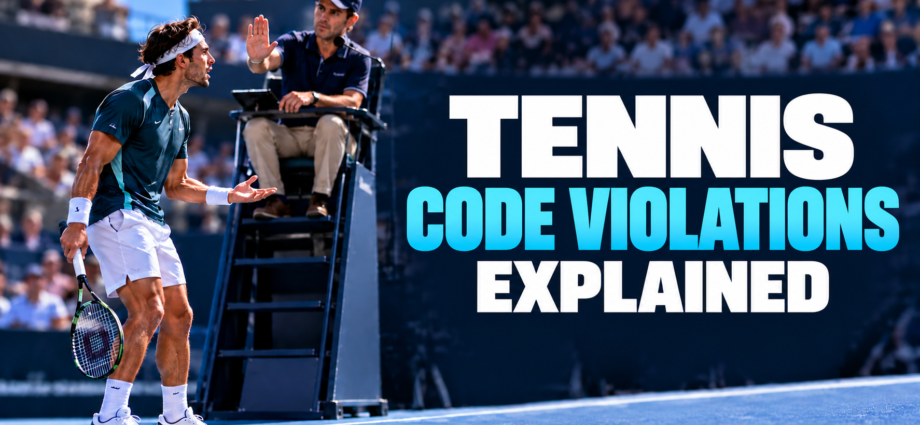
A player smashes a racquet.
The chair umpire announces a code violation and gives a warning.
Twenty minutes later, the same player shouts an obscenity and suddenly loses a point.
Another violation could cost an entire game.
Eventually, it could cost the match.
Professional tennis has a formal system for dealing with inappropriate behaviour, and it can directly alter the score.
But the system is often misunderstood.
A player does not necessarily receive a separate warning for each different type of offence. A warning for racquet abuse can therefore matter later if the player commits an entirely different violation.
Nor does every incident have to progress gradually from warning to point to game. Particularly serious conduct can potentially lead to an immediate default.
Understanding tennis code violations means understanding both what players can be penalised for and how those penalties accumulate during a match.
Quick Answer: What Is a Code Violation in Tennis?
A code violation is a penalty imposed when a player’s behaviour breaches the code of conduct governing a tennis competition.
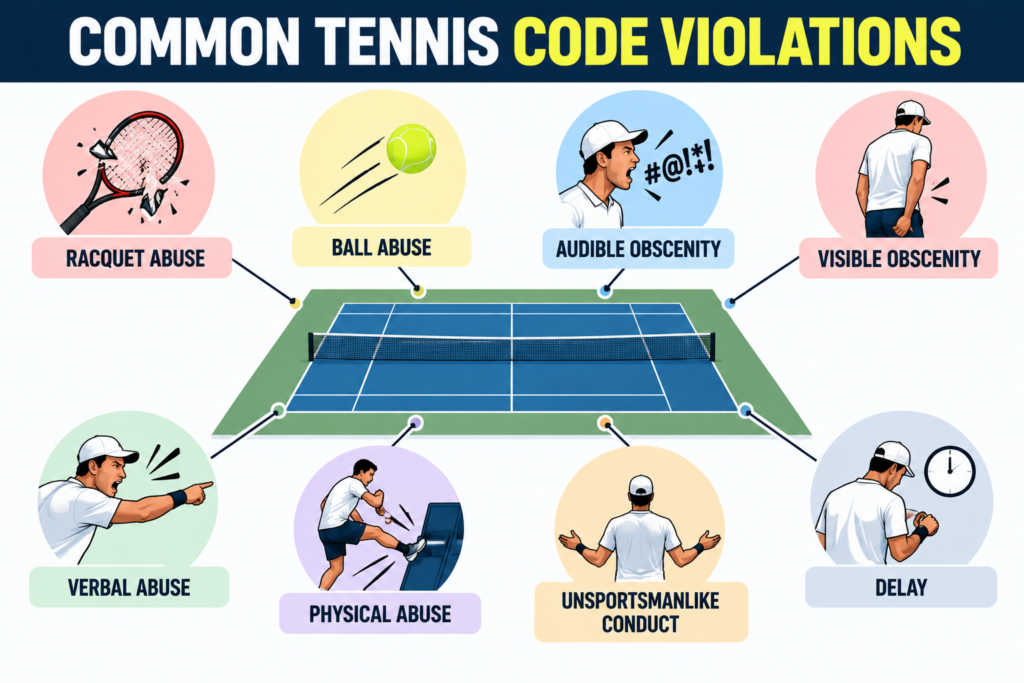
Depending on the applicable rules, offences can include racquet abuse, ball abuse, audible or visible obscenity, verbal abuse, physical abuse, unsportsmanlike conduct and other prohibited behaviour.
On the ATP Tour in 2026, the standard Point Penalty Schedule is:
First offence — Warning
Second offence — Point Penalty
Third and subsequent offences — Game Penalty
After the third code violation, the Supervisor determines whether a subsequent offence should result in default.
The WTA uses the same basic progression in its 2026 rulebook.
Serious misconduct can also result in an immediate default, meaning a player does not necessarily have to work through every previous stage first.
What Is the Tennis Point Penalty Schedule?
The easiest way to understand the system is as an escalating ladder.
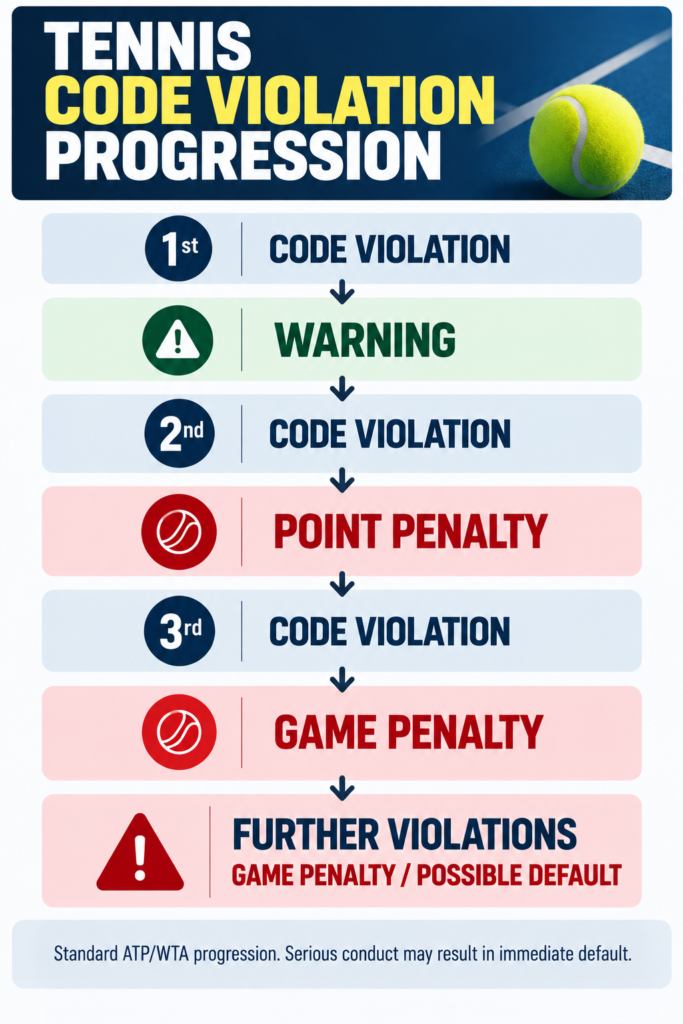
The ATP’s current rulebook states that the first offence receives a warning, the second a point penalty, and the third and each subsequent offence a game penalty. After the third violation, the Supervisor determines whether each subsequent offence should instead constitute a default.
The WTA’s 2026 Point Penalty Schedule follows the same warning → point → game structure.
That progression produces one of the most important aspects of the system:
Different code violations can accumulate.
Imagine a player receives a warning for racquet abuse.
Later, the player commits verbal abuse.
That does not necessarily mean another warning simply because verbal abuse is a different offence. Under the escalating Point Penalty Schedule, the subsequent code violation can result in the next penalty level.
This is why the chair umpire’s first announcement can become significant much later in a match.
What Happens When a Player Receives a Warning?
A warning is the first level of the standard Point Penalty Schedule.
It does not change the score.
The chair umpire identifies the offence and announces the code violation.
For example, ATP officiating procedures give announcements in the form:
“Code Violation, Delay of Game, Warning…”
The precise wording identifies both the offence and the penalty.
Although the warning itself costs no points, it creates an important consequence.
The player has moved onto the penalty ladder.
Another code violation can now cost a point.
Embed from Getty ImagesWhat Is a Point Penalty in Tennis?
A point penalty means exactly what it sounds like:
the offending player loses a point.
The penalty is incorporated into the score.
Suppose the score is 30-30 and a player receives a point penalty. The opponent is awarded the next point through the penalty, changing the score accordingly.
It can therefore be enormously consequential.
A point penalty at 0-0 in an early game may be irritating.
A point penalty at a critical stage late in a set can effectively decide the game.
The penalty does not care whether the next point would have been important.
Once assessed, it becomes part of the match score.
What Is a Game Penalty in Tennis?
A game penalty moves the punishment another level higher.
Instead of losing one point, the player loses an entire game.
The game is awarded to the opponent and the match continues from the resulting score.
Again, context can make the consequence much greater than the words “one game” suggest.
A game penalty at 1-1 in the opening set is damaging.
A game penalty at 5-5 late in a deciding set could put the opponent within a game of victory.
That is one reason repeated misconduct becomes increasingly dangerous for a player.
The penalties are no longer merely disciplinary.
They can determine the sporting outcome.
What Does Default Mean in Tennis?
A default ends the player’s participation in the match because of a rules or conduct violation.
The opponent wins the match.
This is different from a player being unable to continue because of injury or illness.
For more on that distinction, see What Is a Default in Tennis? and What Is a Retirement in Tennis?
Under the ATP’s standard progression, game penalties apply from the third violation onwards, but after the third code violation the Supervisor must consider whether subsequent offences should result in default.
A serious incident can also potentially produce an immediate default.
In other words, the existence of a penalty ladder does not mean a player is entitled to behave progressively worse until reaching its final rung.
Embed from Getty ImagesCan a Tennis Player Be Defaulted Without a Warning?
Yes.
This is one of the most important misconceptions about code violations.
A sufficiently serious offence can result in an immediate default rather than beginning with a warning.
The ITF’s 2026 junior regulations, for example, explicitly state that the Supervisor may declare a default either for a single violation — an Immediate Default — or through the Point Penalty Schedule.
ATP procedures likewise provide a mechanism for the chair umpire to call the Supervisor to court when an immediate default is being considered.
That makes sense.
A penalty system designed to control behaviour cannot reasonably guarantee a player several lesser sanctions before action can be taken against exceptionally serious misconduct.
What Can Cause a Code Violation?
The exact terminology and regulations vary between competitions, but professional codes of conduct cover a broad range of player behaviour.
Common categories include:
- racquet or equipment abuse
- ball abuse
- audible obscenity
- visible obscenity
- verbal abuse
- physical abuse
- unsportsmanlike conduct
- unreasonable delay
- failure to use best efforts
- leaving the court without permission
The ATP Code also contains provisions covering conduct beyond the simple examples spectators most commonly associate with an angry player.
Its rules, for instance, require players to use their best efforts during matches and prohibit leaving the court during a match without permission.
The WTA similarly maintains a detailed Code of Conduct covering player behaviour.
Let’s look at the violations spectators are most likely to encounter.
Racquet Abuse
Smashing a tennis racquet is probably the most recognisable code violation in the sport.
Players become frustrated. Racquets are thrown, slammed into the court or struck against equipment.
The issue is not merely that the racquet might break.
Violent equipment abuse can damage the court, create danger and undermine the standards of behaviour expected at a professional event.
The precise circumstances matter. Accidentally dropping a racquet during a point is obviously different from deliberately smashing it into the court.
Officials judge the conduct within the applicable code.
For spectators, however, the familiar sequence is straightforward:
Frustration becomes deliberate racquet abuse → the chair umpire assesses a code violation → the Point Penalty Schedule applies.
Ball Abuse
A tennis ball is supposed to be hit hard.
So when does hitting a ball become abuse?
Context is everything.
A player striking a ball aggressively as part of a point is playing tennis.
A player angrily launching a ball away after the point has finished is doing something entirely different.
Ball abuse rules are designed to address intentional or reckless misuse of the ball outside normal play.
The danger becomes obvious when balls are struck towards spectators, officials, ball crew or other people around the court.
What might begin as a split-second expression of frustration can therefore become a serious disciplinary incident.
Embed from Getty ImagesAudible Obscenity
Professional tennis does not require players to remain silent.
But clearly audible obscene language can trigger a code violation.
The WTA’s Code of Conduct specifically lists audible obscenity among its player on-court offences, alongside other forms of misconduct.
The surrounding circumstances matter, as does what the relevant official hears.
This is why television viewers sometimes hear a player shout something without an apparent violation, while another incident quickly produces an announcement from the chair.
The official must apply the competition’s code to what occurred on court.
Visible Obscenity
Not all obscenity is spoken.
An obscene gesture can also constitute a violation.
The WTA’s 2026 rules define visible obscenity as the making of signs with a player’s hands, racquet or balls that commonly have an obscene meaning.
The principle is simple: replacing an obscene word with an obscene gesture does not necessarily avoid the code.
Verbal Abuse
Verbal abuse goes beyond general frustration.
It can involve abusive language directed towards an opponent, official, spectator or another person at the tournament.
This distinction is important.
A player shouting in anger at themselves and a player directing abuse at the chair umpire are not necessarily committing the same offence.
Professional codes therefore distinguish between different categories of misconduct.
Officials assess what was said, who it was directed towards and the surrounding circumstances.
Physical Abuse
Physical abuse is considerably more serious.
Professional tennis codes prohibit inappropriate physical conduct towards officials, opponents, spectators and others.
An incident serious enough to fall into this category can potentially move beyond the normal expectation of a simple warning.
Remember: an immediate default is possible for sufficiently serious conduct.
The penalty ladder is not a licence to commit a severe first offence without risking removal from the match.
Unsportsmanlike Conduct
“Unsportsmanlike conduct” is one of the broadest categories.
It exists partly because not every unacceptable act fits neatly into categories such as racquet abuse or audible obscenity.
Tennis codes need the ability to address conduct that is clearly contrary to acceptable sporting behaviour even when it takes an unusual form.
That makes unsportsmanlike conduct something of a catch-all category, although officials still have to apply the actual rules governing the competition.
For recreational players, the broader behavioural expectations are covered in Tennis Etiquette
Are Time Violations the Same as Code Violations?
Not always.
This is an important distinction.
Professional tennis also has specific procedures governing the time players take between points.
ATP officiating procedures distinguish between Code Violations and Time Violations.
For ATP time violations, the first offence is announced as a warning. For subsequent delay by the server, the penalty is loss of the first serve — meaning the server must begin the point with a second serve. For subsequent delay by the receiver, a point penalty applies.
That is different from the ordinary Code Violation progression.
There are also circumstances where deliberate or unreasonable delay can be treated under the Code rather than merely as a routine time violation.
So hearing the chair umpire say “Time Violation” is not necessarily the same thing as hearing “Code Violation.”
Why Does Tennis Have a Serve Clock?
At professional tournaments, visible shot clocks help officials and players monitor the time between points.
The purpose is straightforward: tennis is supposed to proceed continuously rather than allowing players unlimited recovery or preparation time.
The clock does not replace the umpire or the rules. It makes the timing requirement much easier for players, spectators and broadcasters to follow.
A player who repeatedly exceeds the permitted time can therefore face the applicable time-violation procedure.
Can a Player Receive a Code Violation After the Point?
Yes.
Many conduct violations happen immediately after a point has ended.
That is when frustrated players are most likely to throw a racquet, strike a ball away or direct comments towards an official.
The chair umpire can then assess the violation and apply the appropriate penalty before play continues.
ATP procedures also address situations in which another official witnesses conduct that the chair umpire did not see. A line umpire can report the incident, after which the chair umpire determines whether a violation occurred.
There are timing restrictions on how such reports are handled, particularly once subsequent points have been played.
Who Decides Whether There Has Been a Code Violation?
At ATP Tour and ATP Challenger Tour events, on-court code violations are normally assessed by the chair umpire. The Supervisor can also become involved, particularly when serious penalties such as an immediate default are under consideration.
Other professional competitions operate under their own applicable procedures.
That is another reason commentators sometimes say:
Embed from Getty Images“The Supervisor has been called to court.”
It often indicates that the situation has moved beyond an ordinary warning or point penalty and requires higher-level involvement.
Does a Code Violation Carry Over to the Next Match?
The in-match Point Penalty Schedule does not simply continue from one match to another.
If a player finishes one match having received a warning, they do not normally begin their next match already one step away from a point penalty under that match’s penalty progression.
But that does not mean the incident disappears.
Professional codes can impose monetary fines and other disciplinary consequences separate from the score penalties imposed during the match.
The ATP, for example, specifies fines for various offences, and its 2026 Code provides for increased maximum fines for consecutive violations of certain provisions during the same calendar year.
So there are really two different questions:
What happens to the score during this match?
and
What disciplinary consequences can follow afterwards?
They are related, but they are not identical.
Do Code Violations Always Mean a Fine?
Not every penalty should be understood as simply “the player was fined.”
Professional tennis disciplinary systems can combine on-court sporting penalties with financial penalties and, for serious conduct, further disciplinary procedures.
An on-court warning matters because of what another violation could do to the match score.
A fine is a separate financial consequence.
This explains why a player can potentially finish a match without losing a point through the code but still face a financial penalty afterwards.
Conversely, once the Point Penalty Schedule escalates, misconduct can affect the match immediately.
What Happens in Doubles?
On the ATP Tour, code violations in doubles are assessed against the team.
That produces an important consequence.
One player’s behaviour can hurt both players.
If a member of the team commits an offence that results in a point or game penalty, their partner suffers the competitive consequence as well.
It is difficult to imagine a better incentive to keep your temper under control.
Code Violation vs Foot Fault
A foot fault is not the same thing as a behavioural code violation.
A foot fault concerns the legality of the serve and is treated as a service fault.
Likewise, a double fault, ball landing out or touching the net during a point are ordinary playing situations governed by the Rules of Tennis.
A code violation concerns conduct.
The distinction is between playing the point incorrectly and behaving in a way that breaches the competition’s code.
Code Violation vs Default
A code violation is an offence.
A default is one possible ultimate consequence.
Most code violations do not result in default.
A first racquet-abuse violation, for example, may simply produce a warning under the standard schedule.
But repeated violations can escalate towards game penalties and potentially default, while sufficiently serious behaviour can justify consideration of an immediate default.
For a broader explanation of how defaults differ from retirements and walkovers, see What Is a Default in Tennis?
Code Violation vs Tennis Etiquette
Etiquette and code violations also overlap without being identical.
Failing to acknowledge an opponent’s excellent shot might be considered poor Tennis Etiquette
It is not ordinarily a code violation.
Deliberately abusing an official is another matter entirely.
Etiquette concerns the conventions of respectful behaviour.
The code establishes enforceable standards and penalties.
One can make you unpopular.
The other can cost you points, games, money or potentially the match.
Why Tennis Uses an Escalating Penalty System
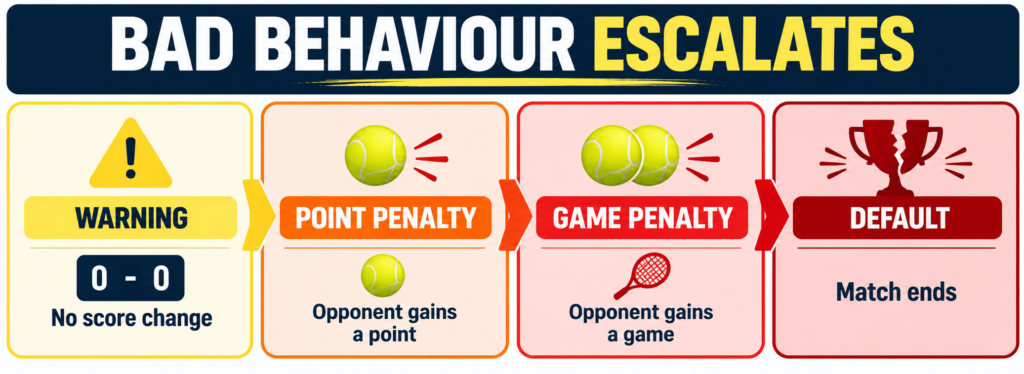
The warning → point → game progression gives officials a way to deal proportionately with repeated misconduct.
A relatively minor first incident can be addressed without immediately changing the score.
If the behaviour continues, the consequences become increasingly significant.
That creates a powerful incentive for the player to stop.
After the warning, another offence can cost a point.
After the point penalty, another can cost a game.
And once the violations continue beyond that stage, the player’s place in the match itself can be at risk.
At the same time, immediate-default provisions allow officials to respond appropriately when an incident is too serious for gradual escalation.
Frequently Asked Questions
What is a code violation in tennis?
A code violation is an official penalty for behaviour that breaches the applicable code of conduct, such as racquet abuse, ball abuse, obscenity, verbal abuse or unsportsmanlike conduct.
What happens after a code violation in tennis?
Under the standard 2026 ATP and WTA Point Penalty Schedules, the first offence receives a warning, the second a point penalty, and the third and subsequent offences a game penalty, with possible default considered after further violations.
Does the second violation have to be for the same thing?
No. The Point Penalty Schedule applies to code violations during the match, so different categories of violation can move a player further through the progression.
Can smashing a racquet result in a code violation?
Yes. Deliberate racquet or equipment abuse can constitute a code violation under professional tennis codes.
Can swearing result in a code violation?
Yes. Audible obscenity is a recognised offence under professional codes of conduct.
Can a tennis player lose a game for bad behaviour?
Yes. Under the standard ATP and WTA progression, the third code violation results in a game penalty.
Can a player be defaulted immediately?
Yes. Serious conduct can lead to consideration of an immediate default without requiring the player to progress through warning, point penalty and game penalty first.
Is a time violation a code violation?
They are not automatically the same. ATP procedures distinguish time violations from ordinary code violations and provide a separate penalty procedure for time violations.
Who gives code violations in professional tennis?
The chair umpire normally assesses on-court violations, with the tournament Supervisor becoming involved where required, particularly in serious situations. ATP rules explicitly give the chair umpire responsibility for on-court code violations at ATP Tour and Challenger events.
Do code violations reset after a match?
The match’s Point Penalty Schedule does not simply carry into the next match. However, fines and broader disciplinary records can still have consequences beyond the match itself.
Final Thoughts
The tennis code violation system is easier to understand once the score penalties are separated from everything else.
For ordinary code violations, remember four words:
Warning. Point. Game. Default.
The first violation tells the player to stop.
The second begins changing the score.
The third can cost an entire game.
Continued misconduct can eventually cost the match.
But the system also recognises that not every offence is equal. Particularly serious behaviour does not have to be treated as though it were merely the first step on a ladder.
That balance is the purpose of the code.
Tennis allows enormous competitive intensity. Players can shout, celebrate, argue a call within the rules and show emotion.
What they cannot do is assume that because the match is important, behaviour has no consequences.
Sometimes those consequences appear on a disciplinary record.
Sometimes they appear directly on the scoreboard.
Continue Reading
- Tennis Etiquette
- Tennis Dress Code
- What Is a Default in Tennis?
- What Is a Retirement in Tennis?
- What Is a Foot Fault?
- On-Court Coaching Rules Explained
For the current professional rules, see the ATP Official Rulebook, WTA Official Rules and World Tennis Rules and Regulations.
Read more of our instructional articles here.
Read more of our player focus articles here.
Follow The Tennis Site on X: @thetennissite
Follow Todd Scoullar on X: @toddscoullar

Comments are closed, but trackbacks and pingbacks are open.