

The ATP Tour stretches far beyond the Grand Slams and Masters 1000 tournaments.
At its foundation is the ATP 250 category.
These tournaments are staged throughout the season and around the world, giving players opportunities to win titles, collect ranking points and compete at the highest level of the regular men’s professional tour.
The name provides the biggest clue to how they work.
Win an ATP 250 singles title and you earn 250 ATP ranking points.
But that doesn’t mean these are minor or developmental tournaments. ATP 250 events are full ATP Tour competitions, often featuring established stars alongside players trying to make the next jump in their careers.
So where exactly do they fit?
What Is an ATP 250 Tournament?
ATP 250 is one of the three main tournament categories operated on the ATP Tour.
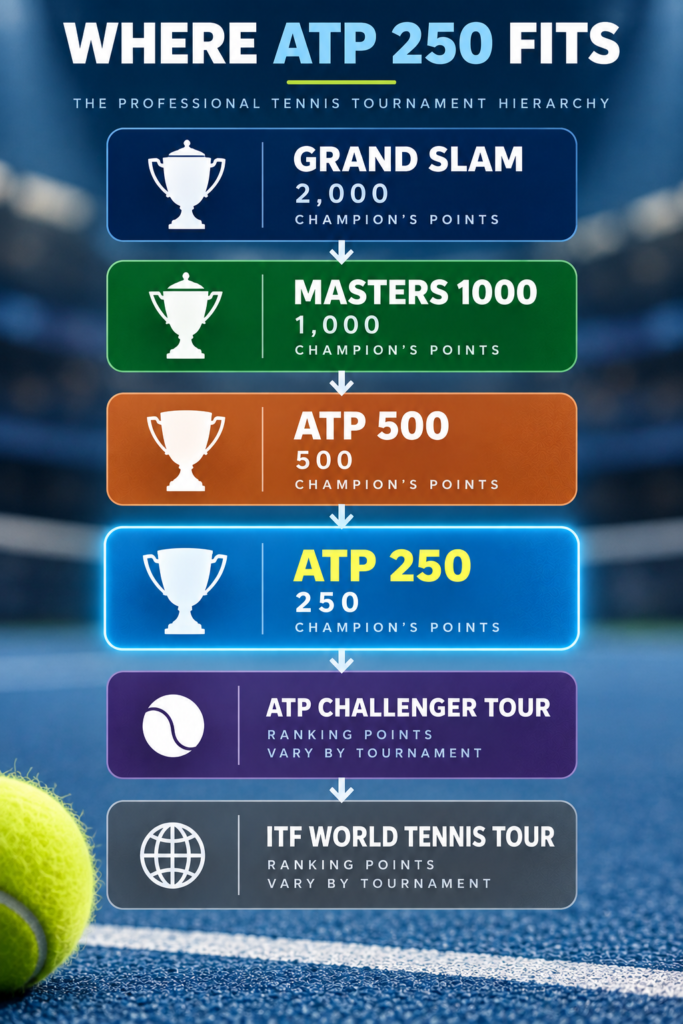
The basic hierarchy is:
Grand Slam — 2,000 champion’s points
↓
ATP Masters 1000 — 1,000
↓
ATP 500 — 500
↓
ATP 250 — 250
The number refers to the ranking points awarded to the singles champion.
ATP 250 is therefore the lowest category on the main ATP Tour, but that description needs some context.
Below the ATP Tour sits the ATP Challenger Tour, followed by the ITF World Tennis Tour.
So an ATP 250 isn’t “low-level professional tennis”. It is the first tier of the main ATP Tour.
How Many ATP 250 Tournaments Are There?
There are (at time of writing) 29 ATP 250 events on the 2026 ATP Tour calendar, although this is expected to shrink sadly.
That makes ATP 250 currently the most numerous category on the main ATP Tour.
They appear almost everywhere in the season.
The year begins with ATP 250 tournaments in Brisbane, Hong Kong, Adelaide and Auckland before the Australian Open.
There are clay events in South America, Europe, North Africa and the United States. There are grass tournaments leading into Wimbledon, hard-court tournaments surrounding the US Open and another group of events through Asia and Europe late in the year.
This wide distribution is part of the category’s importance.
ATP 250 tournaments allow the main Tour to reach considerably more countries and cities than would be possible if the calendar consisted only of Grand Slams, Masters 1000s and ATP 500s.
How Many Ranking Points Are Available at an ATP 250?
The name tells us what the winner receives:
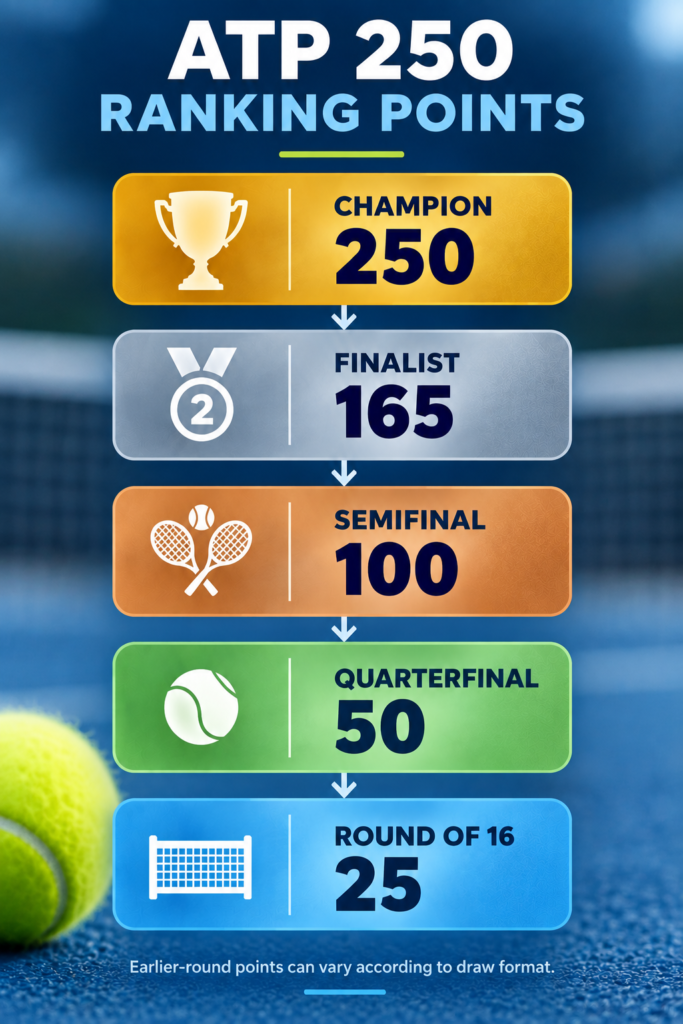
Champion — 250 points
The later rounds follow this structure:
| Result | Ranking Points |
|---|---|
| Champion | 250 |
| Finalist | 165 |
| Semifinal | 100 |
| Quarterfinal | 50 |
| Round of 16 | 25 |
Earlier-round and qualifying allocations can differ according to draw structure.
The important point is that these aren’t insignificant numbers.
A player who wins an ATP 250 collects 250 ranking points in a single tournament.
For someone outside the Top 50, that can make a considerable difference.
ATP 250 vs ATP 500
The difference is particularly easy to understand because an ATP 500 awards exactly twice as many ranking points at the equivalent later stages.
| Result | ATP 500 | ATP 250 |
|---|---|---|
| Champion | 500 | 250 |
| Finalist | 330 | 165 |
| Semifinal | 200 | 100 |
| Quarterfinal | 100 | 50 |
| Round of 16 | 50 | 25 |
That means:
1 ATP 500 title = 500 champion’s points
2 ATP 250 titles = 500 champion’s points
It also produces an interesting comparison.
A player who loses an ATP 500 final receives 330 points, while someone who wins an ATP 250 receives 250.
So when comparing player records, the number of titles alone doesn’t tell the whole story.
Tournament level matters too.
See ATP 500 Explained for more on the category immediately above.
ATP 250 vs Masters 1000
The gap is considerably larger.
A Masters 1000 champion receives:
1,000 points
An ATP 250 champion receives:
250 points
In simple headline terms, four ATP 250 titles produce the same number of champion’s points as one Masters 1000 title.
But again, those achievements aren’t interchangeable.
Masters 1000 events generally feature deeper fields of elite players and occupy a much higher position within the ATP calendar.
The comparison is useful primarily because it demonstrates how the ranking system values the different categories.
See ATP Masters 1000 Explained.
What Surfaces Are ATP 250 Tournaments Played On?
All three major surfaces.
Hard Courts
A large proportion of ATP 250 tournaments are played on hard courts, including indoor and outdoor events.
Conditions can vary considerably between them depending on court speed, climate, altitude and whether the tournament is played indoors.
Clay
Clay also makes up an important part of the ATP 250 calendar.
The 2026 main European clay season includes ATP 250 events in Bucharest, Houston, Marrakech and Geneva alongside the higher-category clay tournaments.
There are also clay-court ATP 250s elsewhere in the season.
Grass
Because the professional grass season is so short, ATP 250 tournaments are particularly important on this surface.
In 2026, Stuttgart and ‘s-Hertogenbosch are played in the first week of the main grass swing, followed later by Mallorca and Eastbourne.
That gives players valuable competitive preparation before Wimbledon.
How Big Is an ATP 250 Draw?
ATP 250 tournaments commonly use compact singles draws.
The 2026 calendar, for example, lists 28-player draws for events including Hong Kong, Adelaide, Auckland, Montpellier, Buenos Aires and Delray Beach, while Brisbane uses a 32-player draw.
A 28-player draw allows four seeded players to receive first-round byes.
A standard 32-player knockout tournament requires five victories from the first round to win the title.
That is considerably shorter than the seven-match path required to win a 128-player Grand Slam.
But smaller doesn’t necessarily mean easy.
ATP 250 draws can contain Top 10 players, established champions, dangerous unseeded players, qualifiers and rapidly improving younger players.
Who Plays ATP 250 Tournaments?
This is one of the more interesting aspects of the category.
An ATP 250 can bring together players at very different stages of their careers.
You might see:
A Top 10 player looking for matches before a Grand Slam.
An established Tour player trying to add another title.
A player around the Top 50 looking for a significant ranking boost.
A young prospect attempting to break through at Tour level.
A qualifier trying to turn a successful qualifying run into something much bigger.
That mixture can create unpredictable tournaments.
A player who rarely reaches the later stages of a Masters 1000 may have a genuine opportunity to challenge for an ATP title at 250 level.
At the same time, the presence of one or two elite players can make an individual ATP 250 draw exceptionally difficult.
Why Do Top Players Enter ATP 250 Tournaments?
If a player can compete for 1,000 points at a Masters event, why play for 250?
Because scheduling isn’t only about maximising ranking points.
A player may enter an ATP 250 because it provides ideal preparation for a Grand Slam, suits their preferred surface or offers valuable match practice after a period away.
Location matters too.
Before the Australian Open, for example, players can compete in ATP 250 events in Brisbane, Hong Kong, Adelaide or Auckland.
The grass season provides another obvious example.
With relatively few weeks available to prepare for Wimbledon, ATP 250 tournaments such as Stuttgart, ‘s-Hertogenbosch, Mallorca and Eastbourne offer important opportunities to compete on grass.
For other players, the attraction is simpler.
An ATP title is an ATP title.
Can Players Qualify for ATP 250 Tournaments?
Yes.
A player whose ranking isn’t high enough for direct acceptance can potentially reach the main draw through qualifying.
Tournament organisers can also award wild cards, while lucky losers can sometimes enter when a main-draw position becomes available.
That makes ATP 250 tournaments particularly important for players trying to establish themselves on the main Tour.
Imagine a player ranked outside the Top 100.
They qualify for an ATP 250.
Then they win two or three main-draw matches.
Suddenly they have earned ranking points, prize money and victories at Tour level — potentially against much higher-ranked opposition.
A single week can change the trajectory of a season.
See What Is a Qualifier?, What Is a Wild Card? and What Is a Lucky Loser?
Is ATP 250 the Lowest Level of Professional Tennis?
No.
This is a common misunderstanding.
ATP 250 is the lowest category on the main ATP Tour.
Below it is an extensive professional structure.
A simplified version looks like this:
Grand Slams
↓
ATP Masters 1000
↓
ATP 500
↓
ATP 250
↓
ATP Challenger Tour
↓
ITF World Tennis Tour
The Challenger and ITF circuits are enormously important because that is where many players earn the ranking points required to eventually gain access to ATP Tour events.
This is also why the jump from Challenger tennis to consistently competing in ATP 250 main draws can be such an important career milestone.
We’ll cover that pathway in much more detail in Challenger Tour Explained and ITF World Tennis Tour Explained.
Do ATP 250 Tournaments All Have the Same Prize Money?
No.
As with ATP 500 and Masters 1000 events, the category number refers to ranking points rather than money.
Individual tournaments can have different prize purses.
Those amounts can also change from year to year.
So “ATP 250” does not mean the tournament has $250,000 in prize money.
It means the singles champion receives 250 ATP ranking points.
See Tennis Prize Money Explained for a deeper look at how professional tennis players are paid.
Why ATP 250 Tournaments Matter for Rising Players
For established stars, an ATP 250 may be one stop among dozens during a season.
For a player trying to break through, it can mean considerably more.
Winning an ATP 250 gives a player:
250 ranking points
An ATP Tour singles title
Prize money
Victories at Tour level
Potential ranking improvement
And that ranking improvement can create further opportunities.
A higher ranking may provide direct entry into tournaments that previously required qualifying. It can improve a player’s chances of reaching Grand Slam main draws and, eventually, produce seeding opportunities.
The process can become self-reinforcing:
Win matches
↓
Earn ranking points
↓
Improve ranking
↓
Gain entry to stronger tournaments
↓
Create opportunities to earn more points
That is why a first ATP title is often such a significant moment in a player’s career.
Frequently Asked Questions
What is an ATP 250?
ATP 250 is a tournament category on the men’s professional ATP Tour. The singles champion receives 250 ranking points.
Why is it called ATP 250?
The number refers to the ranking points awarded to the tournament’s singles champion.
How many ATP 250 tournaments are there?
There are 29 ATP 250 events on the 2026 ATP Tour calendar.
How many points does an ATP 250 finalist receive?
An ATP 250 finalist receives 165 ranking points.
How many points does an ATP 250 semifinalist receive?
A semifinalist receives 100 ranking points.
Is ATP 250 higher than Challenger tennis?
Yes. ATP 250 is part of the main ATP Tour and sits above the ATP Challenger Tour.
Is ATP 250 lower than ATP 500?
Yes. An ATP 500 champion earns 500 ranking points compared with 250 at an ATP 250.
Can Top 10 players play ATP 250 tournaments?
Yes. Highly ranked players can and do compete in ATP 250 tournaments.
Can players qualify for an ATP 250?
Yes. Qualifying provides one route into ATP 250 main draws.
Does ATP 250 mean $250,000 prize money?
No. The number refers to ranking points, not prize money.
Final Thoughts
ATP 250 tournaments may occupy the lowest rung of the main ATP Tour, but that doesn’t make them insignificant.
Quite the opposite.
They are the most numerous tournament category on the Tour, taking professional tennis to cities and countries around the world. In 2026 alone, there are 29 ATP 250 events.
They also provide an important meeting point between different levels of the professional game.
Stars use them for preparation and additional opportunities to win titles. Established players use them to build their rankings. Qualifiers and younger players use them to prove they belong at Tour level.
For many professionals, reaching an ATP 250 main draw is itself an important milestone.
Winning one is bigger again.
It means 250 ranking points and something every professional tennis player wants beside their name:
ATP Tour champion.
Continue Reading
ATP 500 Explained
ATP Masters 1000 Explained
The ATP Tour Explained
Tennis Ranking Points Explained
Tennis Prize Money Explained
Challenger Tour Explained
Read more of our instructional articles here.
Read more of our player focus articles here.
Follow The Tennis Site on X: @thetennissite
Follow Todd Scoullar on X: @toddscoullar

Comments are closed, but trackbacks and pingbacks are open.