
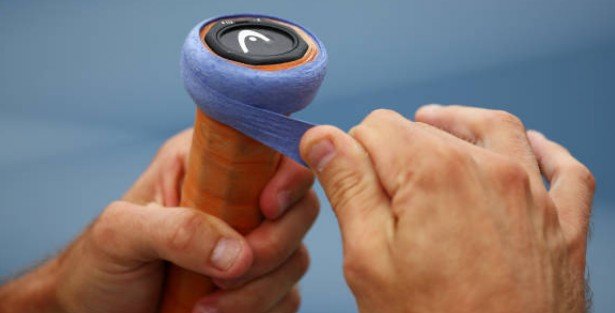
Choosing the right tennis grip size is one of the simplest ways to improve your comfort and confidence on court.
A grip that is too small can cause the racquet to twist in your hand and force you to squeeze the handle too tightly. A grip that is too large can restrict wrist movement, making it harder to generate spin and change grips quickly.
Fortunately, finding the right grip size isn’t difficult.
In this guide, we’ll explain how tennis grip sizes work, how to measure your ideal size and what to do if your racquet doesn’t feel quite right.
Quick Answer
Most adult players use a grip size between 4 1/4 inches (L2) and 4 3/8 inches (L3).
If you’re unsure, it’s generally safer to choose the slightly smaller grip, as overgrips can increase the size if needed.
What Is Tennis Grip Size?
Grip size refers to the circumference of a tennis racquet’s handle.
Manufacturers measure this circumference in inches, while many countries also use a simple numbering system.
The two systems are equivalent.
| Grip Number | Grip Size |
|---|---|
| L0 | 4″ (100 mm) |
| L1 | 4 1/8″ |
| L2 | 4 1/4″ |
| L3 | 4 3/8″ |
| L4 | 4 1/2″ |
| L5 | 4 5/8″ |
Today, L2 and L3 are by far the most commonly sold adult grip sizes.
Why Does Grip Size Matter?
Grip size affects much more than comfort.
It influences how securely you hold the racquet, how easily you change grips and even your risk of injury.
A correctly sized grip allows you to swing naturally without squeezing the handle excessively.
What Happens If Your Grip Is Too Small?
A grip that is too small often causes players to grip the racquet more tightly than necessary.
Possible problems include:
- Excessive wrist movement.
- Racquet twisting during contact.
- Reduced control.
- Hand fatigue.
- Greater risk of tennis elbow.
Many players compensate by squeezing harder, which can actually make the problem worse.
What Happens If Your Grip Is Too Large?
An oversized grip creates different challenges.
Because the handle fills more of your hand, it becomes harder to move the racquet freely.
Possible effects include:
- Reduced wrist flexibility.
- Slower grip changes.
- Less racquet-head speed.
- More difficulty generating topspin.
- Reduced feel.
Although some players intentionally use a larger grip for comfort, most coaches recommend avoiding a grip that’s noticeably too big.
How to Measure Your Grip Size
There are two commonly used methods.
Method 1: The Index Finger Test
Hold the racquet using your normal forehand grip.
There should be enough space to fit the index finger of your opposite hand comfortably between your fingertips and the base of your palm.
If there isn’t enough room, the grip is probably too small.
If there’s a large gap, it’s probably too big.
This is the quickest and most widely used method.
Image: Index finger grip size test.
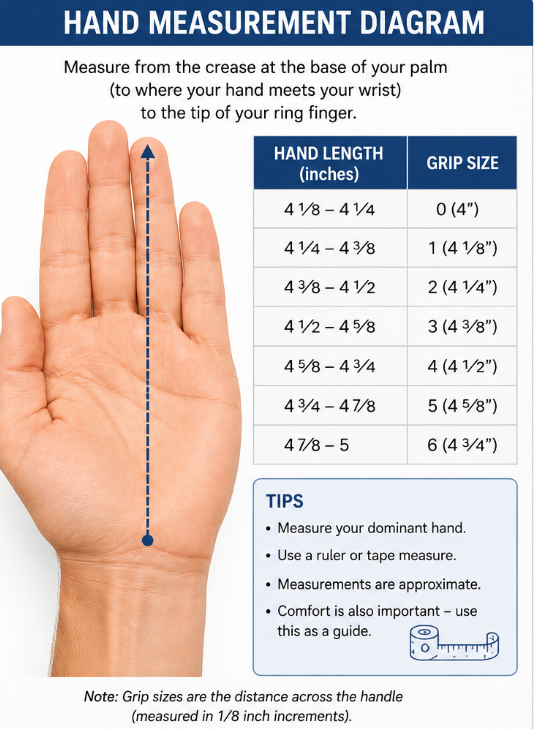
Method 2: Measure Your Hand
Open your dominant hand.
Measure from the middle crease of your palm to the tip of your ring finger.
The measurement gives a good indication of your ideal grip size.
Although not perfect for everyone, it’s an excellent starting point when buying a new racquet.
Which Grip Size Do Beginners Need?
There isn’t a universal grip size for beginners.
Instead, choose the size that fits your hand comfortably.
As a general guide:
- Juniors usually use L0 or L1.
- Most women use L1 or L2.
- Most men use L2 or L3.
These are only guidelines. Hand size varies considerably from person to person.
Should You Choose the Smaller or Larger Size?
If you’re between two sizes, most experts recommend choosing the smaller grip.
Why?
Because increasing grip size is easy.
Adding an overgrip increases the circumference by approximately one-sixteenth of an inch (around 1.5 mm).
Reducing a grip that’s too large is much more difficult.
Can an Overgrip Change Grip Size?
Yes.
An overgrip makes the handle slightly thicker while also providing extra comfort and moisture absorption.
Many players use one or two overgrips to fine-tune the fit.
Replacement grips also vary slightly in thickness, allowing further adjustment.
Do Professional Players Use Different Grip Sizes?
Professional players use a wide range of grip sizes.
Some prefer smaller grips because they allow greater wrist movement and easier spin generation.
Others choose larger grips for additional stability and comfort.
There is no single “professional” grip size.
The best grip is simply the one that feels comfortable and allows you to play confidently.
Common Myths
“Bigger hands always need bigger grips.”
Not necessarily.
Some players deliberately choose a slightly smaller grip to improve racquet-head speed and spin.
“Professionals all use the same grip size.”
False.
Grip size is a personal preference, and you’ll find considerable variation across both the ATP and WTA Tours.
“Grip size affects power.”
Not directly.
Grip size mainly affects comfort, control and manoeuvrability.
Technique remains the biggest factor in generating power.
Frequently Asked Questions
What is the most common tennis grip size?
L2 (4¼ inches) and L3 (4⅜ inches) are the most common adult grip sizes.
Can I make my grip bigger?
Yes.
Adding an overgrip is the simplest way to increase grip size slightly.
Can I make my grip smaller?
Only to a limited extent.
Replacing the grip with a thinner replacement grip may reduce the size slightly, but significantly reducing grip size usually requires changing the handle or buying a different racquet.
Is it better to buy a grip that’s too small or too large?
If you’re unsure, choose the slightly smaller grip.
It’s much easier to increase grip size than reduce it.
Final Thoughts
Choosing the correct grip size isn’t about copying the professionals—it’s about finding what feels comfortable in your own hand.
A properly sized grip improves comfort, control and confidence while reducing the likelihood of unnecessary strain or injury.
If you’re unsure which size to buy, start with the measurements in this guide, test the racquet if possible, and remember that a slightly smaller grip can always be adjusted with an overgrip.
Continue Reading
- Tennis Overgrip vs Replacement Grip
- Tennis Overgrips Explained
- Tennis Grip Size Guide
- How to Choose a Tennis Racquet
- The Complete Guide to Tennis Equipment
Read more of our instructional articles here.
Read more of our player focus articles here.
Follow The Tennis Site on X: @thetennissite
Follow Todd Scoullar on X: @toddscoullar

Comments are closed, but trackbacks and pingbacks are open.