
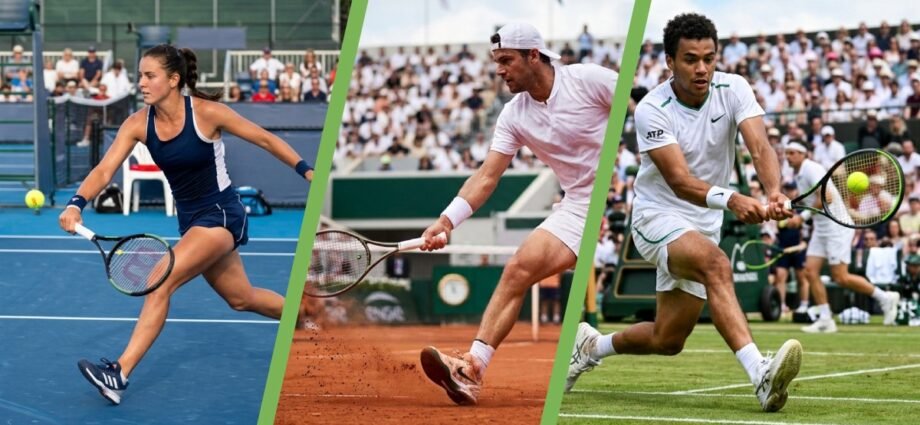
Imagine this, a player hits a perfect, deep topspin forehand on a hard court, winning him a point. But when this player hits this exact same shot on grass, it sits up to be crushed. What do you think happened here?
The player’s the same, their skill remains unchanged, the only difference here is the tennis court surface.
Most club players forget that beyond rackets or their physical forms, the type of tennis court surface they are playing on also plays a huge role in the gameplay. Experienced players understand this and change their gaming strategy accordingly.
In this guide, we’ll break down how different court surfaces affect the ball speed, spin, and shot selection, and player movement across the tennis court. We’ll also outline what the player strategy should be on the three types of tennis court surfaces – hard courts, grass courts, and clay courts.
Why Tennis Court Surfaces Matter More Than Most Players Think
From Nadal’s reigning victory on the clay court and Federer’s title “The Master of Grass” to Djokovic’s record of 10 Australian Open titles on hardcourt, one thing is clear, tennis court surface isn’t simply a passive background. It is an active variable in every single point you earn on the court.
The type of tennis court surface you’re playing on decides not only the ball speed but its bounce height, and the grip too. It can both limit or enhance certain playing styles and determine the skills you need to win the game.
That’s why professional players spend weeks adjusting their training regimens between tournaments.
Fast or Slow? How Court Surfaces Control Ball Speed
Hard Courts – The Balanced Performer
Hard courts are generally made of an asphalt or concrete sub-base that’s coated with acrylic blended with silica sand. This gives the ball a medium-to-fast pace as it retains a moderate amount of its initial speed upon hitting the ground.
Clay Courts – Slower Pace, Longer Rallies
Clay courts are made of crushed stone or brick which creates a gritty surface with rolling friction. This acts as a brake on the ball, absorbing its forward momentum and creating a slower pace with longer rallies.
Grass Courts – Speed, Skid, and Quick Reactions
Grass courts are the fastest among all tennis courts. The natural grass offers the least friction or grip so the ball doesn’t bounce up but skids forward, maintaining a high velocity which forces the players to respond rapidly.
The Bounce Factor: Why the Same Shot Behaves Differently on Every Surface
As each tennis court surface has its own level of friction and hardness, the same tennis shot behaves differently across different surfaces.
Here’s how the court surface affects the shot trajectory:
- The dense asphalt or concrete bases of hard courts reflects energy back into the ball. This offers a true, highly predictable, and medium-high ball bounce.
- Clay courts grip the ball with its loose texture, causing it to kick up into a much higher, looping bounce.
- Grass courts with its slippery blades have the least friction which causes the ball to stay incredibly low on the ground, skidding, and resulting in a fast ball bounce.
How Tennis Court Surface Influences Spin and Shot Selection
The spin of the ball becomes more or less effective depending on how the court surface interacts with it.
Hard tennis courts provide a balanced response to spin. Topspin remains effective, slices stay low, and flat shots maintain enough pace to finish points. As the bounce of a hardcourt is predictable, players can comfortably mix different shot types throughout a rally.
Clay tennis courts reward topspin more than any other court surface. Its high friction grips the spinning ball, causing it to jump higher after the bounce and pushes opponents deeper behind the baseline. This makes heavy topspin essential for winning points on clay courts.
Grass courts often favour slice and flat hitting. Slice shots skid through the surface and stay exceptionally low, while flat serves and groundstrokes reach opponents quickly before they have time to react. Heavy topspin still has value here but it generally doesn’t kick up as strongly as it does on clay.
Footwork Changes Everything: Moving Efficiently across Different Surfaces
Depending on the surface you’re playing on, your footwork should change accordingly. It is essential not just for enhanced performance but also to prevent injuries on the court.
The exceptional traction of hard courts requires players to rely on explosive first steps, quick directional changes, and controlled stopping because the surface offers excellent traction. This can take a toll on a player’s joints and that’s why experienced tennis court builders add cushioning to the court surface.
The loose surface of clay courts allows and also requires players to slide intentionally into their shots to absorb the momentum and recover back to the center of the court quickly.
For grass courts, the slippery surface requires players to use small, controlled adjustment steps to maintain their center of gravity. So, they can react quickly to the low, skidding bounce of the ball.
Besides adapting your footwork to the surface you’re playing on, proper court construction is also important. An experienced tennis court designer ensures that your court has the right traction, drainage, and consistency so players move confidently and safely.
Winning Strategy Starts with Understanding the Surface
Best Strategy for Hard Courts
Hard courts reward versatility. Players should combine aggressive serving with solid baseline consistency and look for opportunities to finish points by attacking shorter balls. Since it has a predictable ball bounce, maintaining depth and changing direction confidently is often more effective.
Best Strategy for Clay Courts
Clay courts require patience. Construct your points carefully using heavy topspin to push your opponents back. While playing on clay, you should also be prepared physically for long rallies.
Embed from Getty ImagesBest Strategy for Grass Courts
Adopt a first-strike mindset on a grass court. Shorten the points by using a classic serve-and-volley strategy by charging or rushing to the net at the first opportunity, taking advantage of the low bounce.
Can a Worn Tennis Court Change the Way You Play?
As tennis courts age, they don’t just look worn out but also begin to play differently. The surface deterioration can lead to inconsistent ball bounce, reduced traction, and uneven footing. This affects both the performance and safety of players on the court.
That’s why regular maintenance and tennis court resurfacing is vital to restore the court. It addresses any surface damage before it becomes a huge safety hazard. Seeking professional help for resurfacing can also extend the lifespan of your court.
Choosing the Right Tennis Court Surface for Your Playing Style
You can’t simply say which surface is best for playing tennis as each surface rewards different strengths. And you should choose your court based on your playing style.
- Choose hard courts if you prefer an all-rounded game. Its consistent bounce and moderate speed suits players who mix baseline rallies with aggressive net play.
- Choose clay courts if your game relies on endurance, topspin, and strategic point construction. Its slower pace gives you more time to chase down shots and wear down your opponents.
- Choose grass courts if you thrive on fast serves, quick reactions, and attacking play. Its low, skidding bounce favors players who like to finish their points early.
Schools, clubs, and homeowners should make this decision after considering the maintenance requirements of each court, their climate, budget, and expected court usage. This ensures better performance, longevity, and long-term value of your facility.
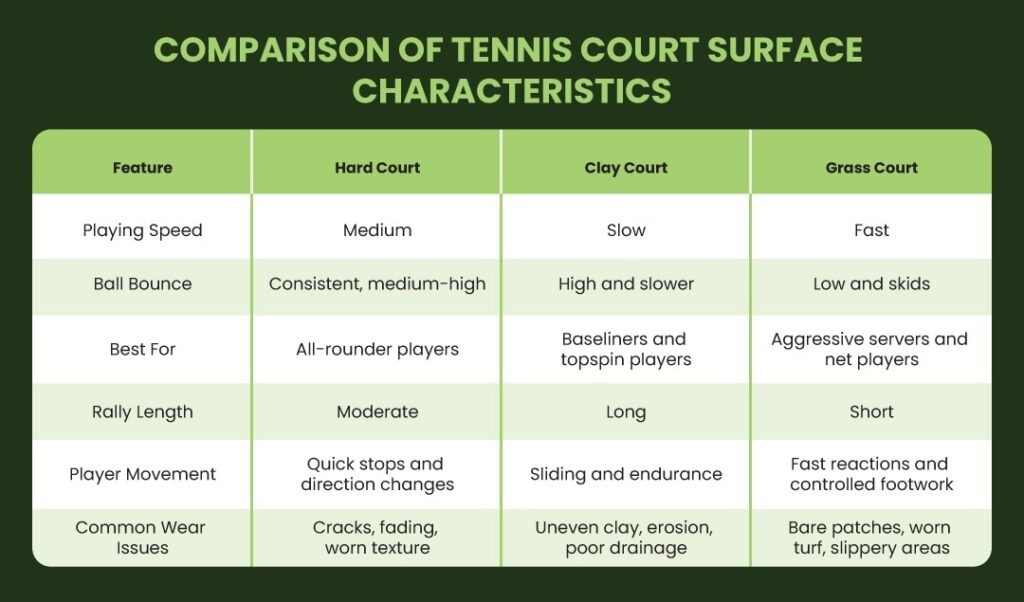
Quick Comparison: Hard Court vs Clay vs Grass
Conclusion
The type of tennis court you’re playing on influences every aspect of the game, from ball speed and bounce to spin, movement, and shot selection. That’s why understanding how each surface plays is important to adapt your strategy instead of fighting against the court.
Whether you’re playing on hard, clay, or a grass court, a well-designed and properly maintained court with regular tennis court resurfacing ensures consistent performance, predictable ball behavior, and a safe playing experience.
If you’re planning to build a new court or restore an existing one, prefer to work with an experienced tennis court designer so your court surface delivers predictable performance for years to come.
Read more of our instructional articles here.
Read more of our exclusive feature articles here.
Find out more here: Facebook
Follow The Tennis Site on X: @thetennissite

Comments are closed, but trackbacks and pingbacks are open.