
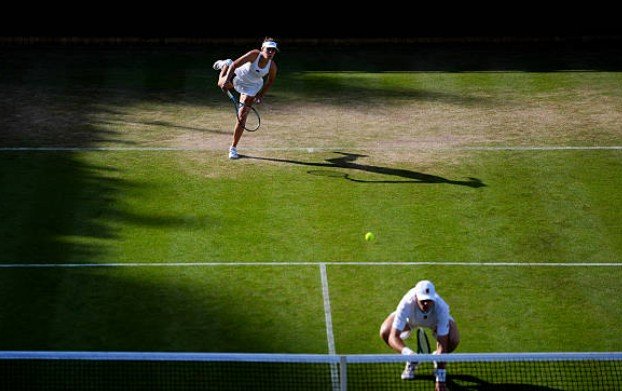
You’ve probably heard the saying that there’s no ‘I’ in team, yet in doubles tennis, this tactic proves that idea can be bent in your favour. You’ve probably watched doubles for years, but never tried it in your own game. In this article, I’ll walk you through how the ‘I’ formation works and how you can apply it successfully in your matches.
The ‘I’ setup is a classic tactic of elite doubles play, bringing together subtle signals and lightning-quick reflexes that often produce exciting, high-speed rallies. The good news is it’s not just for professionals — it can be a game-changer at club level too. It’s an excellent way to throw off opponents who are used to predictable, standard formations, though trying it for the first time might feel a bit bold.
The basics are straightforward: Ahead of the point, the server assigns roles — one partner covers the sideline while the other handles the cross-court return. The net player crouches low in the middle of the service box, then darts in the opposite direction from their partner, either cutting across to intercept or sliding over to protect the alley.
1. When to bring it out:
I often advise using the ‘I’ formation during a match when opponents are finding their rhythm on returns, or starting with it straight away against pairs known for aggressive returning.
It creates psychological pressure by making them question court space and hesitate just a fraction longer. This hesitation buys your team precious time to close in on the net. The core goal is pushing them toward lower-percentage shots, such as going up the line over the taller part of the net — an area many players dislike. It also disrupts their net player, freeing your partner to cover cross-court while you take the line volley.
2. How to make it work on the court:
To lower the chance of getting punished with a clean winner down the line, I strongly recommend serving down the centre (the T) on both sides.
A powerful serve straight down the middle makes it much tougher for the returner to whip the ball up the line from that spot. Once the ball is in play, the net player crosses, forcing the opponent into a difficult angled shot — particularly challenging when stretched, as it demands solid core strength.
Lefty-righty teams can alternate sides based on natural serving angles for added variety. The secret is deploying it selectively to keep opponents off-balance. It can work even better on clay surfaces, or when you need a reliable option on second serves.
3. Important risks to consider:
While useful, this isn’t a tactic to overuse. It carries some gamble because it opens up the alleys while one player shifts across, potentially allowing a precise returner to finish the point outright with a single strong shot.
If the opponent manages a sharp down-the-line return, you’ll need a solid Plan B ready to go.
4. Handling the ‘I’ Formation as a Returner:
Coming up against a well-drilled ‘I’ formation can be daunting if you’re not prepared. The best approach is to decide your target early and commit before the serve is struck.
On first serves, pick your spot and go with it. Second serves often give you extra time to read the developing play and aim toward the deeper-positioned player.
Focus your eyes on the server’s movement rather than the net player, then direct the ball that way. Experienced returners do this because skilled net teams frequently shift to distract you. Targeting the server pulls the net player out of position — they’re typically the more immediate threat.
Essential Reminders
- Bring out the ‘I’ formation at well-timed moments rather than too often.
- Stay alert to vulnerabilities like exposed alleys that could confuse your own side.
- Quick thinking is crucial when returning against it.
- Aiming back at the server tends to be the smartest response.
Used wisely, the ‘I’ formation adds a sharp, disruptive edge to your doubles game and can create those small advantages that add up over a match.
Read more of our exclusive feature articles here.
Read more of our player focus articles here.
Follow The Tennis Site on X: @thetennissite
Follow Todd Scoullar on X: @toddscoullar

Comments are closed, but trackbacks and pingbacks are open.