
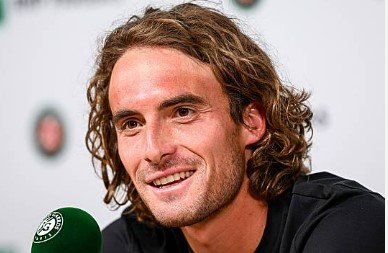
Stefanos Tsitsipas is back in Melbourne for his 9th main draw appearance. Australia has been a happy hunting ground for the Greek superstar, having reached the final in 2023, and the semi-finals 3 times.
This time around, there’s not as much pressure or hype on him, having dropped in the rankings due to injuries, mental health, and lack of form. It’s hard to believe, but Tsitsipas won just 2 matches across all 4 Major tournaments in 2025.
He’s holding on to a seeded position here (31) by the skin of his teeth, but with no points to defend, it gives him a great opportunity to start the new season on a good note.
In fact, he’s already done that, with 3 singles wins in the United Cup, including a stunning performance, defeating top 10 player, Taylor Fritz. Perhaps the old Stefanos Tsitsipas isn’t too far away.
Speaking to the press during that campaign, he spoke about how important playing these lead-up matches are to him.
“I think it helps, first of all, building the capacity in your lungs to withstand matches like this. One thing that is going through your mind when you’re playing a long match like that is, this is such a great preparation before the Aussie Open.
The format is different there, best-of-five. Getting tough matches in makes you a better player, improves your IQ as a player. You get to try things. You get to experiment with a few things you’re not entirely sure about when you’re on the court.
In my case, the more I get to spend time on the court, the more I get to figure out certain things. Matches always help. I’m a matches person. I’ve always been. It feeds my creativity. It feeds my zone of understanding that should be done more and maybe we should improve this. It always works as feedback. It is important having matches like this before a big slam.”
His Body is Holding Up
Thankfully, the chronic back injury that required surgery towards the end of last season, appears to have him back on track, without pain.
“I have a lot of faith in the doctor that treated me. He’s considered one of the best. I am really thankful that he had the opportunity to see me and help me out because my situation was quite urgent. There were a lot of things on the line for me. I had to clear those things out.”
For Tsitsipas, it’s a reminder that being on court and being healthy is a privilege, and isn’t something he takes for granted anymore.
“The absence from the court teaches you so much about what else could happen, what other routes you can take besides tennis. In that particular moment of my life, I wouldn’t see tennis competing wasn’t something that I was doing. I was trying to get back.
Training was mostly something that I was in my daily life. The most important thing, what I understood through the last couple of months, is health. If you manage to get healthy, then competition is fun, your daily life is fun. If you’re struggling with health-related problems, it can have a big toll on you mentally. Thankfully I have other things I did in my life, ventures and other interesting things in my life that could occupy that space that I’m used to my entire life.
When you are injured, you don’t even have that feedback, because you’re just, like, barely making the court to try and play a match. There are different types of concerns that hits you when you are in that type of situation.”
The Mental Side of Injuries
Arriving in Melbourne, Tsitsipas opened up about the mental aspect of having a serious back complaint during Australian Open media day.
“Spinal injuries scientifically are proven that they affect the brain too. You can look it up.
I’ve done a lot of research on it. Spinal injuries are not funny at all. The spine in general is the most sensitive area of your body, so if that’s affected, it can really have an effect on you mentally too.
I feel like if you don’t have a healthy mind, it affects your mind, and if you don’t have a healthy mind, also physically you’re struggling. Your body starts collapsing too when you are mentally not well.
Seeing myself in a situation like that, I don’t even — honestly, I don’t even, I reached a point where I don’t even prioritize results anymore. I don’t even care about results. Results don’t even matter to me. What matters is training properly and not feeling pain and not being bothered by anything.”
The Tennis Calendar Needs Adjusting
The length of the tennis season has been an ongoing discussion amongst players and fans for a number of years now. Tsitsipas is firmly in the camp that the calendar is too long, and too hard on players bodies.
“I don’t think it’s a coincidence that so many players were injured in 2025, and there is a statistic that I saw. I think we haven’t had a year like that with so many retirements.
I personally believe it’s a direct correlation to what the tour is doing to us. I don’t think it’s accidental that this happened this year. Masters 1000s are way too long. I think there’s a formula that can be applied on that where you reduce a few days here and there, and you just have the perfect formula, just little tiny adjustments to make it work.”
Expanding on those comments, Tsitsipas doesn’t expect massive changes to the tour. But he would like to see the tour work with the players, and make some small adjustments to allow players extra recovery time. He understands that there’s no way all the Masters events will revert back to 7 days, but 12 days is too much.
“When you have Masters 1000s for 12 days — that’s how I see it from the outside as a player. I’m not interested in watching 12 days of a Masters 1000. I want to probably make it max ten days. If you want a show, make it a ten-day tournament. People are engaged the whole time. People don’t lose focus. When you make tournaments and turn them into marathons, not everyone is going to follow.
Bercy, is one of the great examples. You get the tournament done in seven days, and everyone is excited. Everyone is watching the tennis. Everyone is following the tennis. There’s a lot of good matches in a short period of time. It’s a success the way Bercy does it, the way Monte Carlo does it. These are great tournaments to watch.”
For now, Tsitipas won’t be at all concerned if his time in Melbourne extends beyond 7 days, 10 days, or perhaps even longer. However, the most important thing, is that Tsitsipas remains healthy and fit. The rest will look after itself.
Read more of our exclusive feature articles here.
Read more of our player focus articles here.
Follow The Tennis Site on Facebook and X: @thetennissite
Follow Todd Scoullar on X: @toddscoullar

Comments are closed, but trackbacks and pingbacks are open.