
By Andrew Pace
Confidence in tennis can be misleading because it often feels strongest when everything around you is familiar. You know the level of the players you train with. You understand where you sit in the group. You recognise the patterns of the opponents you are likely to face. Even a difficult match takes place inside a world that makes sense to you.
Then the environment changes.
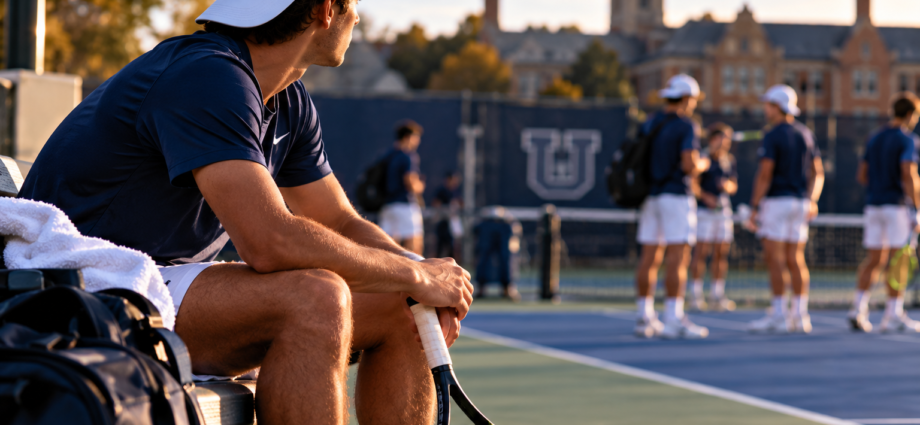
For me, moving from France to the United States and entering college tennis changed more than the format of competition. It changed the reference points I had been using to judge myself. New players, new coaches, a team environment, different expectations and a different rhythm of competition made it much harder to rely on the simple feeling of, ‘I know where I belong here.’
That is where I started to understand the difference between confidence built from familiarity and confidence that can survive uncertainty.
The title of this piece is not really about being the literal best player in a room. Most competitive players are rarely in that position for long. It is about what happens when you move into an environment where your usual signs of competence disappear. You are no longer certain how good you are compared with everyone else. You may lose more often. You may have a smaller role. You may need to prove things that people in your old environment already knew about you.
That can feel like your confidence has disappeared. Sometimes, though, it is simply being tested in a new way.
Familiarity can look like confidence
There is nothing wrong with feeling comfortable in a familiar environment. In fact, athletes need periods where they can compete freely and trust their game. The problem comes when comfort becomes the only evidence we use to tell ourselves that we are confident.
If confidence depends on winning a certain percentage of sets, being one of the stronger players in practice or receiving regular reassurance from a coach, it can collapse very quickly when those conditions change.
A stronger or unfamiliar environment exposes that dependence. Suddenly you can play a good practice set and still lose. You can train well and still not have the role you want. You can improve while the people around you improve too. If your only question is ‘Am I better than them?’, a useful training environment can start to feel like constant failure.
College tennis forced me to pay more attention to a different question: ‘Am I becoming more capable in this environment?’
That question is less comfortable, but it is much more useful.
Being uncomfortable gives you better information
When you are pushed outside a familiar competitive setting, weaknesses become harder to hide. That does not always feel good, but it gives you clearer information.
Maybe your first serve becomes less reliable when opponents return aggressively. Maybe you discover that your decision-making changes when you are nervous. Maybe you realise that you were used to controlling rallies in one environment and now need to defend, reset points and tolerate longer periods without feeling in control.
The instinct is often to interpret these moments as evidence that you are not good enough. I have found it more helpful to treat them as evidence about what needs to improve next.
That shift sounds small, but it changes the emotional weight of a bad practice or a difficult match. A loss is still disappointing. A poor session is still frustrating. The difference is that neither has to become a verdict on your level.
Confidence is not the same as certainty
One of the biggest lessons I have taken from college tennis is that confidence does not mean expecting everything to go well. It means believing that you can respond when it does not.
Before a match, certainty would be knowing that you are better than the opponent and expecting to win. Confidence is different. You may not know how the match will go, but you trust that you can compete, adjust and stay present when the score becomes uncomfortable.
The same idea applies to a place on a team. You may not know exactly where you will play, how much you will compete or how quickly you will earn the role you want. Confidence is being able to keep working without needing those answers immediately.
That kind of confidence is slower to build because it is not created by one good result. It comes from collecting evidence that you can handle uncertainty without falling apart.

Sports become serious before most athletes realize they have.
It happens when training begins to affect school, money, sleep, travel, family plans, identity, and decisions that cannot be solved simply by working harder.
When Sports Get Serious is a practical decision guide for ambitious young athletes and the families supporting them.
Instead of asking how badly you want success, Andrew Pace examines the questions that determine whether an ambitious sports project can actually hold up: What does the next level require? Who owns the decision? What does the project really cost? Which opportunities deserve a yes? What should never be sacrificed simply to prove commitment?
A team environment changes what ‘doing well’ means
College tennis also complicates confidence because your performance is no longer only about your own result. You are part of a team. Your role can change. Another player can be selected ahead of you. You can play well while the team loses, or struggle individually while still contributing through your preparation and energy around the group.
That can be difficult for players who are used to judging themselves almost entirely through individual results.
I have found it useful to separate three things: my current role, my current level and my long-term potential. They are related, but they are not identical.
A smaller role today does not automatically mean you are getting worse. A loss does not erase the work you have done. A teammate playing better than you can be frustrating, but it can also raise the standard you see every day.
The challenge is to use the environment without allowing every comparison to become personal.
Build confidence from things that travel with you
The most durable sources of confidence are the ones you can carry into a new team, a new country, a new tournament or a stronger level of competition.
For me, that means paying attention to things such as how consistently I train, how I react after a poor point, whether I can identify what is breaking down in my game, and whether I keep making useful decisions when the match becomes uncomfortable.
Those are not as satisfying as a ranking or a win-loss record because they do not give you a single number. But they are much harder for a change of environment to take away.
There are a few practical habits that help. After a difficult session, identify one specific thing that was exposed instead of judging the whole session as bad. When you enter a stronger group, give yourself time before deciding what your position in that group says about you. Ask coaches specific questions about what would make you more useful or more competitive. Most importantly, keep a part of your identity outside the result you produced that day.
The room is supposed to get harder
Competitive athletes spend years trying to reach better environments. Then, when they finally enter one, it can be unsettling to feel less impressive than before.
But that is often the point.
If every room you enter immediately confirms what you already believe about yourself, you may not be stretching very far. A room that makes you question your level can also force you to build a more reliable form of confidence, one based less on status and more on your ability to learn, adjust and keep competing.
I still care about results. Every competitive player does. I still want to win, improve my level and earn the strongest role I can. The difference is that I no longer think confidence has to wait until I feel superior to the people around me.
Sometimes confidence is simply being willing to stay in the room long enough to become better in it.
Continue Reading
- Emily Appleton: From Junior to Pro
- Jan Kumstat: 17 Matches to Change Everything
- Alexis Blokhina: From Stanford to ITF Success
- What Parents Should Do After a Junior Loss
Read more of our exclusive feature articles here.
Read more of our player focus articles here.
Follow more of Andrew Pace’s writing: https://andrewpacebooks.com
Follow The Tennis Site on X: @thetennissite

Comments are closed, but trackbacks and pingbacks are open.