
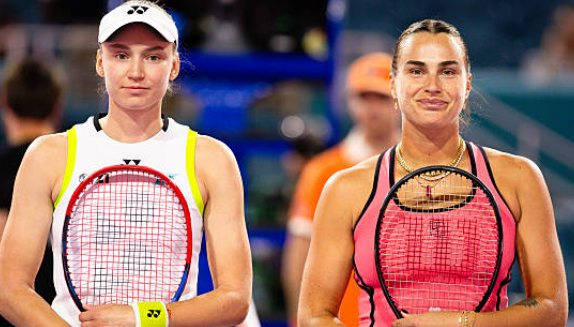
The Grand Slam season will finish as it began, with Aryna Sabalenka and Elena Rybakina facing each other across a hard court with one of tennis’s biggest prizes between them.
Seven months after Rybakina recovered to defeat Sabalenka in the Australian Open final, the two leading players in the women’s game will meet again in Saturday’s US Open championship match. This time, Sabalenka is pursuing a third consecutive title in New York, while Rybakina is attempting to complete a two-major season and celebrate her impending rise to world No. 1 with another Grand Slam trophy.
Embed from Getty ImagesIt will be their 18th meeting on the WTA Tour, with Sabalenka leading their head-to-head 10-7. It will also be their third meeting in a major final.
Their first came at the 2023 Australian Open, when Sabalenka recovered from a set down to win her first Grand Slam singles title. Rybakina reversed that result in Melbourne this year, again in three sets, after rallying from 3-0 down in the decider.
Sabalenka responded by defeating Rybakina in two more finals during the North American spring, winning at Indian Wells and again in the Miami semi-finals. She therefore holds the recent advantage, but Rybakina won their most important encounter of the season.
“We played many times,” Rybakina said after reaching the final. “She’s a very aggressive player. It’s difficult to play with her, mentally, physically, because she has big game, big serve.
“I will need to come with all the energy I will have, bring my best serve against Aryna and, yeah, make the right decisions in the right moment, because most of the times it’s tight, tight score. This is where the decision makes a difference.”
That assessment pretty much sums up the narrow margins that so often define the rivalry. Both players are capable of taking control with the serve and the first groundstroke, but their matches are rarely decided by power alone. The winner is often the player who manages her aggression more effectively when neither is given time to settle.
Sabalenka arrives with the stronger record in New York but also has the weight of history possibly on her shoulders. She is appearing in her fourth consecutive US Open final, having finished runner-up in 2023 before winning the title in 2024 and successfully defending it last year.
Victory on Saturday would make her the first woman to win three consecutive US Open singles titles since Serena Williams completed the feat from 2012 to 2014. It would also give Sabalenka her fifth Grand Slam singles title, adding to her Australian Open victories in 2023 and 2024 and her two US Open crowns.
Embed from Getty ImagesHer winning streak at Flushing Meadows now stands at 20 matches. Since the beginning of the 2022 tournament, she has compiled a 31-2 record in New York, with her only defeats coming against Iga Swiatek in the 2022 semi-finals and Coco Gauff in the 2023 final.
Sabalenka has also reached the final at eight consecutive hard-court Grand Slam tournaments, an Open Era record across men’s and women’s tennis. Steffi Graf, Martina Hingis and Novak Djokovic each reached seven successive finals at hard-court majors.
The top seed has dropped only one set during this year’s tournament. She defeated Camila Osorio 6-2, 6-4, qualifier Polina Iatcenko 6-1, 6-1, Kamilla Rakhimova 6-3, 6-4 and Taylor Townsend 6-4, 6-3 to reach the quarter-finals.
Her only extended examination came against Wimbledon champion Linda Nosková. Sabalenka prevailed 7-6(1), 3-6, 7-6(7), winning the deciding 10-point tie-break 10-7. She then produced one of her best performances of the tournament to defeat No. 3 seed Jessica Pegula 7-5, 6-2 in the semi-finals.
Pegula was unequivocal about the level she faced.
“I think that’s definitely — you can ask her — probably the best match she’s played this year,” Pegula said. I mean, I thought her level was insanely high. I don’t know who pissed her off today. Hopefully it wasn’t me totally, but it might have been. I don’t know. She played insane. She played a super high level. Honestly, I don’t really know if there was much I could do today.”
Sabalenka has struck a tournament-leading 170 winners and converted 25 break points, also the highest total in the women’s draw. She has spent eight hours and 47 minutes on court across her six matches.
Her winner-to-unforced-error differential across the Grand Slam tournaments this season stands at plus 141, comfortably the best among the women, with Pegula next at plus 21.
Sabalenka acknowledged that her desire to finish the Grand Slam season successfully has sharpened her focus in New York.
Embed from Getty Images“It kind of like feels for me, talking about Grand Slams, a last push of the season,” she said after defeating Pegula. “I wanted it badly, to go to the final, and of course I want to go all the way. The mentality was just, I’m ready. I’m ready for whatever it’s going to take to get the win.”
Her preparation for the final will not change.
“I keep the same routine,” Sabalenka said. “As I said, last couple of months really teach me how to shut down the noise from outside. I think that’s what’s the meaning behind all of those tough lessons, to finally learn how to stay focused on myself and forget about the outside noise.
“It sounds simple, but it’s not really simple to do sometimes. Nothing’s going to change for me.”
Rybakina’s journey has been less straightforward, but no less impressive. The second seed has spent nine hours and 43 minutes on court and dropped two sets, both during comeback victories in the final stages of the tournament.
Embed from Getty ImagesShe began with a 6-3, 6-2 victory over American wild card Thea Frodin, then defeated Jessica Bouzas Maneiro 6-2, 6-4. Yuliia Starodubtseva tested her in the third round before Rybakina advanced 7-6(6), 6-3.
Her most authoritative performance came against two-time US Open champion Naomi Osaka in the fourth round. Rybakina won 6-1, 6-4, producing the controlled first-strike tennis that will be required against Sabalenka.
The next two rounds revealed another side of her game. Rybakina recovered from a set down to defeat qualifier Zheng Qinwen 3-6, 6-1, 6-4 in the quarter-finals. That victory also secured enough ranking points for her to become world No. 1 for the first time when the new rankings are released on Monday.
She will replace Sabalenka, ending the Belarusian’s 99-week consecutive reign at the top. The result of the final will not change that outcome: Rybakina will be No. 1 and Sabalenka will move to No. 2.
Rybakina then came from behind again in the semi-finals, defeating No. 4 seed Coco Gauff 3-6, 6-4, 6-4 in two hours and eight minutes.
Gauff recovered from 4-1 down in the second set and later broke Rybakina as she served for the match at 5-3 in the third. Rybakina immediately broke back to complete the victory.
“She does a great job of just being there every point and putting a lot of pressure on you on the service game and return game,” Gauff said. “I think she was able to hold the line a bit better than I could tonight.”
Embed from Getty ImagesThe victory placed Rybakina in her first US Open final and the fourth Grand Slam final of her career. She won Wimbledon in 2022, lost the 2023 Australian Open final to Sabalenka and defeated her in Melbourne this year.
She is also only the fifth player in the past 20 years to reach the Australian Open and US Open finals in the same season, following Justine Henin, Victoria Azarenka, Angelique Kerber and Sabalenka.
Since the conclusion of last year’s US Open, Rybakina has recorded an 18-6 record against Top 10 opponents. Her 75 per cent winning rate against that group is the best on the WTA Tour over that period.
Her serve remains the clearest tactical threat. Rybakina has struck 42 aces at this tournament, the second-highest total in the women’s draw behind Nosková. Her 143 winners place her third overall.
Sabalenka knows that neutralising the first strike will be essential.
“If it’s Elena, it’s going to be a really — it’s going to be really tough match,” Sabalenka said before the match-up was confirmed. “She’s a big server. She really improved over the years on the baseline game, so it’s going to be physically and mentally tough match.
“As I said, I’m ready for the fight. I’m ready to do everything to get the win.”
The tactical contest will begin with the serve, but the return may ultimately prove more important. Rybakina will look to win quick points and prevent Sabalenka from establishing an aggressive position inside the baseline. Sabalenka will attempt to pressure Rybakina’s second serve while protecting her own from one of the cleanest returners in the women’s game.
Both players prefer to dictate, which means neither will be comfortable surrendering court position. If one is consistently forced behind the baseline, the balance could change rapidly. We may see a classic ‘push/pull’ kind of match.
There is also a contrast in the pressure surrounding them. Sabalenka is defending a title, a winning streak and her unbeaten record in New York since 2023. Rybakina has already secured the No. 1 ranking and can approach the final knowing she has achieved a major career milestone regardless of Saturday’s result.
“It’s important match, and since it’s a final, I feel like it doesn’t matter who is on the other side,” Rybakina said. “You just want to win and do your best.
“I don’t want to put too much pressure on myself, because we are all very close in the ranking. Even if something goes wrong in the final, I still have another opportunities, another tournaments until the end of the year.”
Rybakina also sees the rivalry as a measure of where her game must continue to improve.
“We push each other when we play these matches, and you clearly can see on what you need to work more,” she said. “I think that’s great that you play against someone who pushes you till the limits.”
The winner will receive $5.5 million and 2,000 ranking points, while the runner-up will earn $2.8 million and 1,300 points. More importantly, the result will settle the final major title of 2026 and add another significant chapter to one of the best rivalries in women’s tennis.
A Sabalenka victory would complete the first US Open women’s three-peat in 12 years and give her a fifth major. A Rybakina victory would make her a two-time Grand Slam champion in the same season and allow her to begin her reign at No. 1 as the holder of both hard-court major titles.
Sabalenka owns the better overall head-to-head record and a 20-match winning streak at the tournament. Rybakina owns their most recent Grand Slam final.
We should be in for a classic!
Read more of our exclusive feature articles here.
Read more of our player focus articles here.
Follow The Tennis Site on X: @thetennissite
Follow Todd Scoullar on X: @toddscoullar

Comments are closed, but trackbacks and pingbacks are open.