
Tennis scoring looks strange the first time you see it.
Fifteen, thirty, forty. Love. Deuce. Advantage. Tiebreaks.
It doesn’t behave like any normal sport, and yet once you understand the structure behind it, it becomes one of the most logical scoring systems in sport.
At its core, tennis is simple:
Points build games. Games build sets. Sets decide matches.
Everything else is detail.This guide breaks it all down clearly, with real match context so you can actually follow what’s happening the next time you watch a match.
The Structure of Tennis Scoring
Every tennis match is built on four layers:
- Points
- Games
- Sets
- Match
A player must win enough of each layer to progress to the next.
- 4 points (with a 2-point lead) wins a game
- 6 games (with a 2-game lead) wins a set
- 2 sets (best-of-three) or 3 sets (best-of-five) wins a match
That’s it. Everything else is how those layers interact under pressure.
Why Tennis Uses 15, 30, 40
One of the most unusual parts of tennis is the scoring sequence: 15, 30, 40.
Instead of 1, 2, 3, tennis uses:
- 0 points → Love
- 1 point → 15
- 2 points → 30
- 3 points → 40
- 4 points → Game (if ahead by two points)
The exact origin isn’t fully confirmed, but the most widely accepted theory links it to old French clock based scoring systems.
Whatever its origin, it has survived because it works within the rhythm of tennis — especially under pressure.
How a Game Is Won
A player must win at least four points to win a game, but there is a condition:
They must also lead by two clear points.
So these scores can all win a game:
- 40–0
- 40–15
- 40–30
But at 40–40, everything changes.
That’s where tennis becomes most interesting.
What “Deuce” Really Means
When both players reach 40–40, the score is called deuce.
From this point:
- A player must win two consecutive points to win the game
This creates tension because one point is never enough.
The flow becomes:
- Deuce
- Advantage Player A
- Back to Deuce (if Player A loses next point)
- Advantage Player B
- Game (if Player B wins next point)
Some of the longest and most important games in tennis history have come down to repeated deuce exchanges.
Momentum swings rapidly — especially at professional level.
Advantage: The Most Pressure-Filled Moment in Tennis
“Advantage” simply means a player is one point away from winning the game.
You’ll hear:
- Advantage server
- Advantage receiver
But the key detail is this:
Nothing is decided yet.
If the player with advantage wins the next point, they win the game.
If they lose it, the score returns to deuce.
This is why tennis feels so different from most sports — a single point can flip the entire outcome of a game multiple times.
How a Set Is Won
A set is made up of games.
To win a set, a player must:
- Win 6 games
- Lead by at least 2 games
So these scores win a set:
- 6–0
- 6–2
- 6–4
- 7–5
But if the score reaches 5–5, the set is still alive.
A player must then win two consecutive games to take it 7–5.
If neither player can break away, the set reaches 6–6.
That’s where the tiebreak comes in.
The Tiebreak Explained Simply
A tiebreak replaces the long cycle of games at 6–6.
Instead of traditional scoring, players count points normally:
- 1, 2, 3, 4…
To win a tiebreak, a player must:
- Reach 7 points
- Lead by 2 points
So tiebreaks can end:
- 7–3
- 7–5
- 8–6
- 10–8
- 17-15
The winner of the tiebreak wins the set:
7–6
This system prevents sets from continuing indefinitely while still keeping pressure high.
Best-of-Three vs Best-of-Five Sets
Not all tennis matches are the same.
Best-of-Three Sets
Used in:
- Most ATP and WTA matches
- Most regular tour events
First player to win 2 sets wins the match.
Best-of-Five Sets
Used in:
- Men’s Grand Slam singles matches
First player to win 3 sets wins the match.
This is why Grand Slam matches can last over five hours — especially when sets go to tiebreaks or extended games.
Break of Serve: The Most Important Moment in Tennis
In professional tennis, serving is a major advantage.
So when a player wins a game while returning serve, it is called a break of serve.
Breaks matter because:
- They are statistically harder to achieve
- They often decide sets
- They shift momentum instantly
A typical set might be decided by just one break of serve.
For example:
- Player A breaks once
- Both players hold serve otherwise
- Final set score: 6–4
That single game often determines the entire set.
Real Match Context: Why Scoring Feels So Dramatic
Take a high-level rally situation.
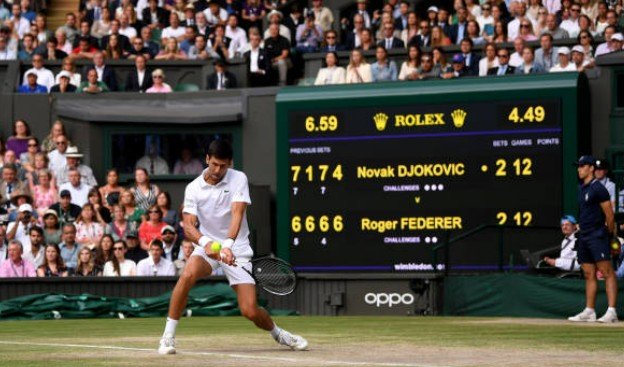
In a match between Novak Djokovic and Roger Federer, a single service game might swing like this:
- 30–0 (server dominating)
- 30–30 (sudden pressure)
- 30-40 – Break point
- Deuce
- Advantage server
- Deuce
- Break point again
- Game
Within a few minutes, total control can disappear.
That’s the essence of tennis scoring — nothing is secure until the final point is won.
Why Tennis Scoring Creates So Much Pressure
Tennis is unique because:
- Every point has high value
- Games can swing from control to chaos instantly
- Sets can turn on one break of serve
- Matches can pivot on a single tiebreak
Unlike timed sports, there is no clock to protect a lead.
You must finish the job.
That’s why players often talk about “playing the big points well” — because those are the ones that define the match.
Tennis Scoring at a Glance
If you need a quick reference:
- 1 point = 15
- 2 points = 30
- 3 points = 40
- 4 points (with 2-point lead) = Game
- 6 games (2-game lead) = Set
- 7–6 = Set decided by tiebreak
- 2 sets (or 3 in Slams) = Match
Everything flows from this structure.
Frequently Asked Questions
Why is tennis scored 15, 30, 40?
It likely originated from historical French scoring systems, possibly linked to clock-based increments.
What is deuce in tennis?
What is a break in tennis?
A break occurs when a player wins a game while returning serve.
What happens at 6–6 in a set?
A tiebreak is usually played to decide the set.
How many sets do you need to win a match?
Most matches are best-of-three sets. Men’s Grand Slams are best-of-five.
Final Thoughts
Tennis scoring looks complicated at first glance, but it’s built on a simple idea: structured pressure.
Points matter because they build games. Games matter because they build sets. And sets matter because they decide matches.
Once you understand that flow, tennis becomes much easier to follow — and far more compelling to watch.
Because in tennis, nothing is ever truly safe until the final point is played.
Continue Reading
- The Ultimate Tennis Glossary: 60 Tennis Terms Every Fan Should Know
- What Is Topspin in Tennis?
- What Is a Let in Tennis?
- The Complete Guide to Tennis Equipment
Read more of our exclusive feature articles here.
Read more of our player focus articles here.
Follow The Tennis Site on X: @thetennissite
Follow Todd Scoullar on X: @toddscoullar

Comments are closed, but trackbacks and pingbacks are open.